Creating a Sustainable, Environmentally Responsible Dental Practice: Rationale and Practical Steps
-
By
-
Derek Sanders
-
Mark S. Wolff
-
Michael Glick
-
Julian Fisher
-
October 30, 2026
Clinical Report: Creating a Sustainable, Environmentally Responsible Dental Practice
Overview
The article presents sustainability as a component of dental-practice resilience, linking preparedness for environmental disruptions with long-term operational and financial viability. It identifies 4 guiding principles and discusses digital workflows, waste management, patient-care operations, facility design, and resource conservation as practical approaches. It also acknowledges the environmental costs and operational trade-offs associated with these strategies.
Background
Dental practices operate amid changing oral health priorities, local regulations, labor and material costs, and environmental hazards that may disrupt routine care and recovery. The article defines resilience as the capacity to anticipate, withstand, recover from, adapt to, and move forward from shocks and disruptions.
Its framework encompasses emergency preparedness and recovery; planet-centric, prevention-focused care; sustainable resource and waste management; and proactive environmental resilience. The authors argue that sustainable dental practices can contribute to the ability of individuals and communities to withstand disruption and adapt to changing circumstances.
Data Highlights
Area | Article findings and practical considerations |
|---|---|
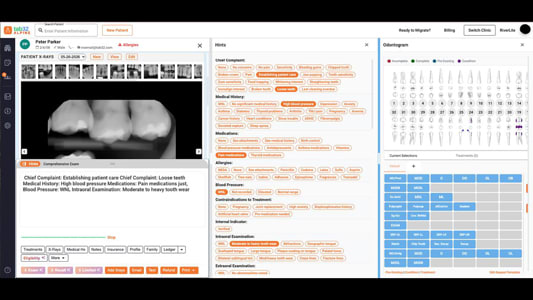
Digital records and communication | Electronic health records and patient portals can reduce paper use, postal communication, and storage needs. Cloud-based records and images can support recovery of patient information after events such as fire or flooding. |
Digital imaging and impressions | Digital photography and radiology avoid film, processing chemicals, and lead. Digital intraoral records may replace elastomeric impressions; the article notes that these materials are not recyclable and do not degrade in landfills. |
Digital workflow trade-offs | Digital media consume electricity and have environmental impacts from manufacture and disposal. Recycling can reduce disposal impacts; avoiding printed models is described as the more environmentally friendly choice when feasible. |
Inventory and waste | The 4 Rs—reduce, reuse, recycle, and rethink—are presented as aligned with lean management and circular-economy principles. Meticulous inventory management may reduce waste, deliveries, packaging, and costs, whereas just-in-time inventory requires more frequent deliveries. |
Key Findings
The article identifies 4 principles for sustainable practice design and operations: emergency preparedness and recovery; planet-centric, prevention-focused care; sustainable resource and waste management; and proactive environmental resilience.
Environmental disruptions discussed include flooding, rising temperatures, hurricanes, tornadoes, and power interruptions.
Digital records, patient portals, and cloud storage can reduce paper and storage requirements and support recovery of patient information after office damage.
Digital imaging avoids film, processing chemicals, and lead, while digital intraoral workflows may reduce nonrecyclable impression waste and transportation associated with prosthetic fabrication.
Electronic technologies also consume electricity and create environmental effects through their manufacture and disposal.
Inventory controls, reusable products, disinfectable packaging, instrument kits, and waste segregation may reduce waste and operating costs.
Teledentistry, risk-based recall, coordinated appointments, and consolidation of procedures may reduce unnecessary patient travel.
Sustainability measures involving infection control should not compromise patient or provider safety.
Clinical Implications
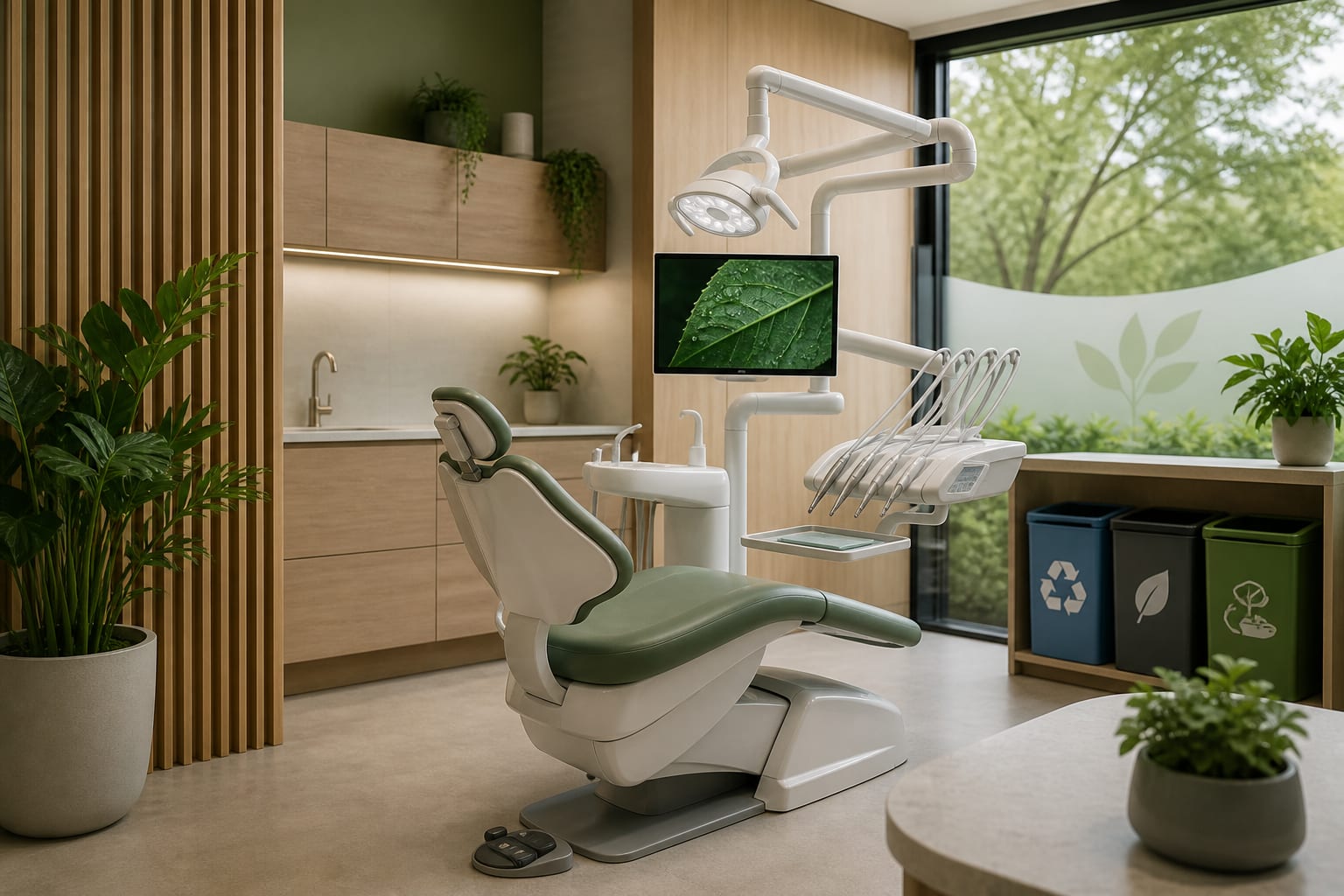
The article presents sustainability as a practice-wide consideration encompassing emergency preparedness, digital operations, procurement, waste management, patient scheduling, infection control, facility design, and water and energy conservation.
Dental practices can evaluate digital workflows for their potential to reduce paper, imaging materials, impression waste, and transportation while accounting for electricity use and end-of-life effects. The article also supports careful inventory management and application of the 4 Rs, while recognizing that single-use items may contribute to infection control and that operational changes must preserve safety.
Conclusion
Environmental responsibility and resilience are interconnected considerations in dental-practice design and management. Practices may strengthen long-term viability through preparedness, prevention-focused care, digital workflows, efficient resource use, comprehensive waste management, sustainable facility design, and adaptive planning. Each strategy should be assessed for its environmental, clinical, operational, and financial trade-offs.
Related Resources & Content
Sanders D, Wolff MS, Glick M, Fisher J. Building an eco-friendly sustainable health care practice: how and why. J Am Dent Assoc. Published online October 30, 2026.
Fisher J, Glick M. Dentistry in a changing world: from inertia to action. Br Dent J. 2025;239(8):559-560.
Antoniadou M. Integrating lean management and circular economy for sustainable dentistry. Sustainability. 2024;16(22):10047.
Khanna SS, Dhaimade PA. Green dentistry: a systematic review of ecological dental practices. Environ Dev Sustain. 2019;21(6):2599-2618.
US Environmental Protection Agency. Technical and Economic Development Document for the Final Effluent Limitations Guidelines and Standards for the Dental Category (40 CFR 441). EPA-821-R-16-005; 2016.
United Nations Environment Programme. Minamata Convention on Mercury: Text and Annexes. Accessed August 19, 2026. https://minamataconvention.org
World Health Organization. WHO Guideline on Environmentally Friendly and Less Invasive Oral Health Care for Preventing and Managing Dental Caries. World Health Organization; 2015.
Guerra M, Morgado M, Leira Y, et al. Integrating sustainability in dentistry: a pathway towards achieving the UN 2030 agenda. Front Oral Health. 2025;6:1549020.
National Research Council. Energy-Efficiency Standards and Green Building Certification Systems Used by the Department of Defense for Military Construction and Major Renovations. National Academies Press; 2013.
US Environmental Protection Agency. WaterSense at Work: laboratory and medical equipment—7.2 vacuum pumps. Published March 2024. Accessed January 4, 2026. https://www.epa.gov/system/files/documents/2024-03/ws-commercial-bmp-watersenseatwork_section7.2_vacuumpumps.pdf
Based on findings from:
Building an eco-friendly sustainable health care practice: How and why
Derek Sanders, Mark S. Wolff, Michael Glick, Julian Fisher. Journal Of The American Dental Association, 2026.
https://jada.ada.org/article/s0002-8177(26)00462-9/fulltext
This content is an AI-generated, fully rewritten summary based on a published scholarly article. It does not reproduce the original text and is not a substitute for the original publication. Readers are encouraged to consult the source for full context, data, and methodology.