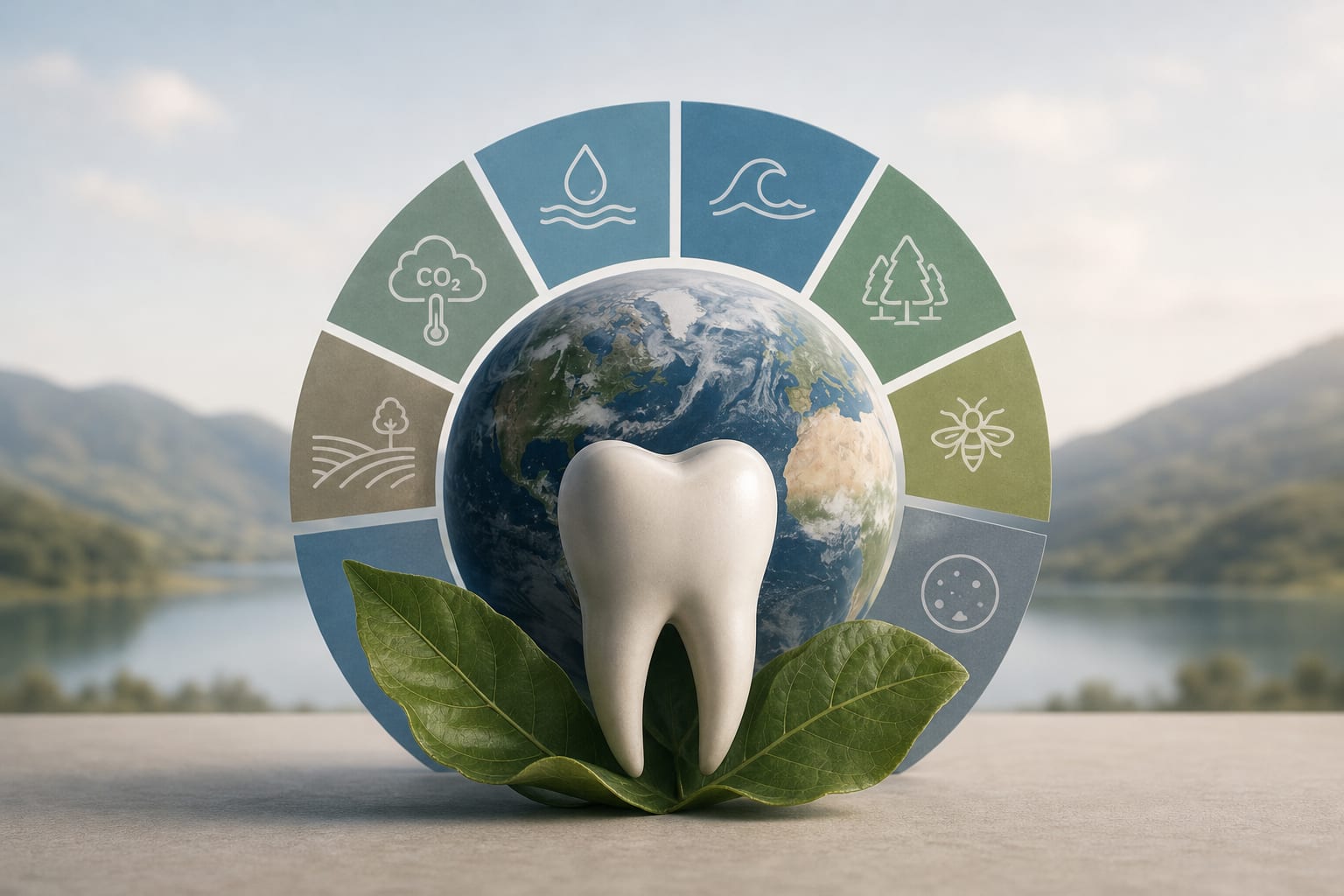
Incorporating Planetary Health into Evidence-Informed Clinical and Public Health Guidelines for Oral Health
-
By
-
Alonso Carrasco-Labra
-
Francisca Verdugo-Paiva
-
Ankita Shashikant Bhosale
-
Camila Avila-Oliver
-
Carolina Martins-Pfeifer
-
Olivia Urquhart
-
Julian Fisher
-
Michael Glick
-
October 30, 2026
Clinical Report: Incorporating Planetary Health into Oral Health Guidelines
Overview
The article presents a conceptual framework for incorporating planetary health considerations into evidence-informed clinical and public health oral health guidelines. It explains how environmental evidence can be integrated into established guideline-development processes through a dedicated planetary-boundaries criterion and a planetary-health subjudgment within the existing equity criterion. The framework is presented as a contribution to ongoing methodological discussion, not as an established protocol.
Background
The planetary-boundaries framework describes biophysical thresholds that collectively define a safe operating space for humanity and other forms of life. Transgression of these boundaries can contribute to extreme heat, food and water insecurity, changing infectious disease patterns, and disruptions to health services.
Dental care contributes to environmental burdens through energy and water use, greenhouse gas emissions, chemicals, materials, and waste. The authors argue that these effects can be considered alongside clinical benefits and harms, certainty of evidence, values, equity, resource use, acceptability, and feasibility when developing oral health guidelines.
Data Highlights
The narrative review presents a conceptual framework and does not report numerical clinical-trial results.
The planetary-boundaries criterion records the direction and absolute magnitude of effects on relevant planetary boundaries and produces an overall cross-boundary determination.
The planetary-health equity subjudgment considers equity across species, generations, and people living today, with particular attention to disadvantaged populations.
Life cycle assessment quantifies environmental effects from cradle to grave across products, services, procedures, and clinically appropriate alternatives.
Planetary-health considerations can be incorporated into panel composition, question scoping, evidence synthesis, evidence-to-decision judgments, recommendation formulation, and guideline updating.
Potential oral health applications include visit frequency, delivery models, reusable versus single-use pathways, instrument reprocessing, procurement, and high-volume consumables.
Key Findings
Statements or guidelines from relevant medical associations were the facilitators most frequently cited in a referenced systematic review of physicians’ adoption of patient-planetary health cobenefit prescribing.
Dental care contributes to environmental burdens through energy and water consumption, greenhouse gas emissions, chemicals, materials, and waste.
In many countries, dental services operate relatively independently from broader health care systems, leaving dental professionals to make treatment and waste-management decisions without local environmental policies.
Prevention-focused care, risk-based recall intervals, minimally invasive approaches, and teledentistry may maintain or reduce undesirable clinical outcomes while decreasing travel, consumable use, and energy demands.
When clinically appropriate options have comparable benefits and harms but different environmental footprints, guideline panels may consider the option with the lower environmental burden.
Life cycle assessments can inform comparisons involving clinical products, services, procedures, visit frequency, reusable and single-use pathways, reprocessing, and procurement.
The planetary-boundaries criterion allows panels to record the direction and absolute magnitude of environmental effects and formulate an overall cross-boundary judgment.
The planetary-health equity subjudgment considers effects across species, generations, and people living today, particularly disadvantaged populations.
Environmental considerations should not compromise infection prevention and control, clinical effectiveness and safety, patient autonomy, or equitable access to care.
Clinical Implications
The framework provides guideline panels with a structured method for considering environmental effects alongside established evidence-to-decision factors. Population-level questions involving care delivery, visit frequency, procurement, consumables, and instrument processing may be especially suitable when clinically comparable alternatives have meaningfully different environmental footprints.
Panels can use life cycle assessments or other environmental evidence to document the direction, magnitude, certainty, and context of environmental effects. When evidence is unavailable, uncertain, or was not sought, the panel should record that status transparently. The article does not establish clinical recommendations for individual patients or prescribe how panels must resolve conflicts between human-health and planetary-health considerations.
Conclusion
Incorporating planetary-health considerations into oral health guideline development is feasible and warranted as a conceptual contribution to an evolving methodological field. Existing decision frameworks can accommodate an environmental lens when clinically comparable options differ in environmental footprint. Transparent assessment of environmental evidence may help panels address cobenefits, trade-offs, equity, and implementation while preserving infection prevention, effectiveness, safety, autonomy, and access to care. The guideline community has not yet reached consensus on how these considerations should be integrated systematically.
Related Resources & Content
Carrasco-Labra A, Verdugo-Paiva F, Bhosale AS, et al. Integrating planetary health into clinical and public health evidence-informed practice guidelines in oral health. J Am Dent Assoc. 2026. doi:10.1016/j.adaj.2026.06.016.
Piggott T, Saadat P, Herrmann A, et al. Integrating planetary health in health guidelines (GRADE Guidance 46). Ann Intern Med. 2026;179(6):874-884. doi:10.7326/ANNALS-25-04761.
Carrasco-Labra A, Urquhart O, Bhosale AS, et al. American Dental Association living evidence-informed guidelines: shaping the future of clinical and public oral health decision making. J Am Dent Assoc. 2026;157(3):213-217.
Rockström J, Donges JF, Fetzer I, Martin MA, Wang-Erlandsson L, Richardson K. Planetary boundaries guide humanity’s future on Earth. Nat Rev Earth Environ. 2024;5(11):773-788.
Vieira RJ, Sousa-Pinto B, Herrmann A, et al; ARIA 2024-2025 Guideline Panel. A novel approach to consider planetary health in guideline development: a GRADE approach using the Allergic Rhinitis and Its Impact on Asthma 2024-2025 guidelines as a case study. J Allergy Clin Immunol Pract. 2025;13(10):2600-2607. doi:10.1016/j.jaip.2025.04.060.
Borglin L, Pekarski S, Saget S, Duane B. The life cycle analysis of a dental examination: quantifying the environmental burden of an examination in a hypothetical dental practice. Community Dent Oral Epidemiol. 2021;49(6):581-593.
Sharma B, Swanton B, Kuo J, et al. Use of Life Cycle Assessment in the Healthcare Industry: Environmental Impacts and Emissions Associated With Products, Processes, and Waste. Agency for Healthcare Research and Quality; 2024.
International Organization for Standardization. ISO 14040:2006 Environmental Management—Life Cycle Assessment—Principles and Framework. International Organization for Standardization; 2006.
International Organization for Standardization. ISO 14044:2006 Environmental Management—Life Cycle Assessment—Requirements and Guidelines. International Organization for Standardization; 2006.
Chartres N, Aung MT, Norris SL, et al. Development of the Navigation Guide Evidence-to-Decision Framework for Environmental Health: Version 1.0. Environ Sci Technol. 2025;59(9):4230-4244.
HealthcareLCA Database. Centre for Planetary Health & Sustainable Care. Accessed April 14, 2026. https://healthcarelca.com/database
Based on findings from:
Integrating planetary health into clinical and public health evidence-informed practice guidelines in oral health
Alonso Carrasco-Labra, Francisca Verdugo-Paiva, Ankita Shashikant Bhosale, Camila Avila-Oliver, Carolina Martins-Pfeifer, Olivia Urquhart, Julian Fisher, Michael Glick. Journal Of The American Dental Association, 2026.
https://jada.ada.org/article/s0002-8177(26)00449-6/fulltext
This content is an AI-generated, fully rewritten summary based on a published scholarly article. It does not reproduce the original text and is not a substitute for the original publication. Readers are encouraged to consult the source for full context, data, and methodology.