Clinical Report: A School-Based Teledentistry Model for People With ASD
Overview
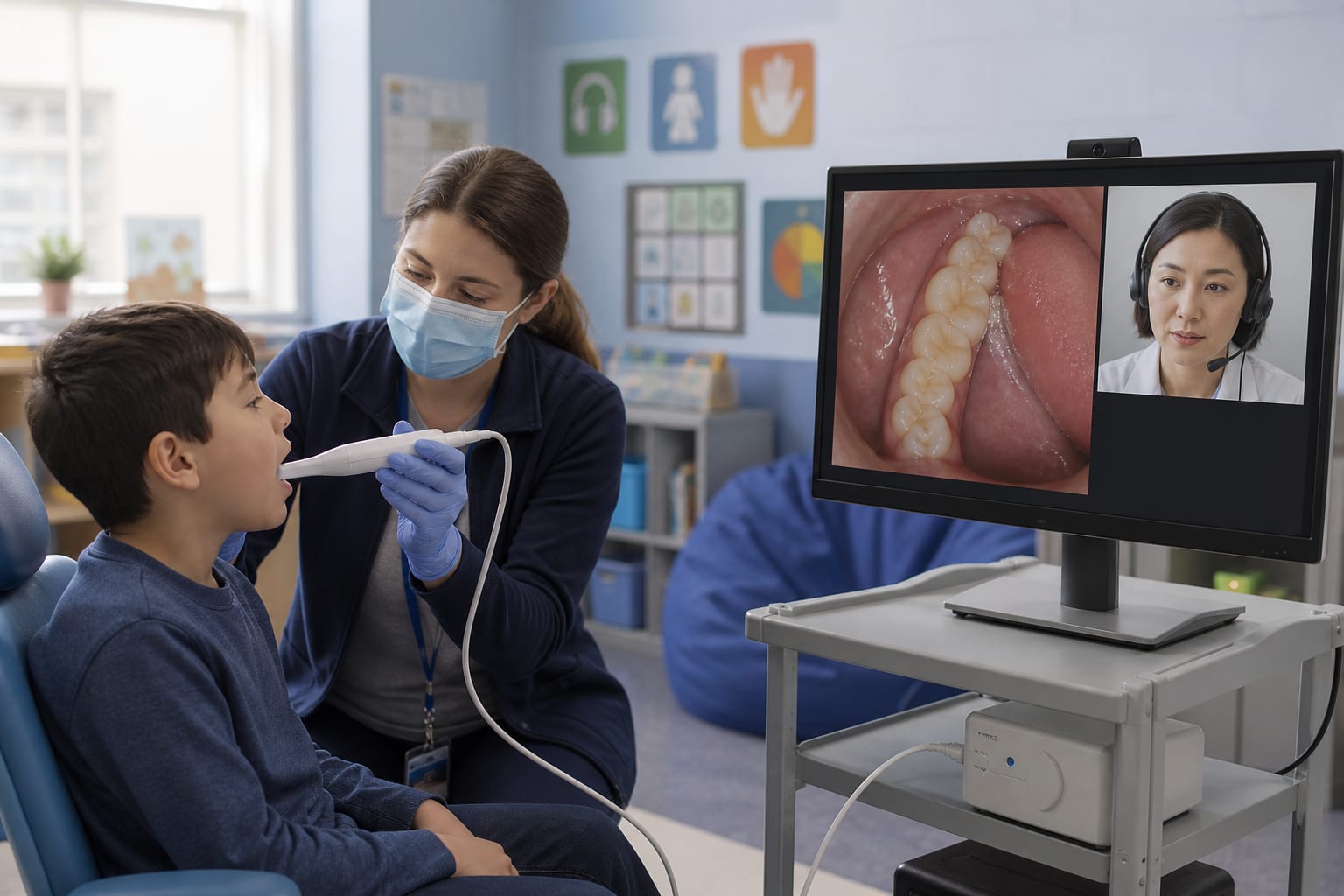
An interprofessional team developed and implemented a school-based teledentistry workflow at Amego School to address barriers to dental care among students with autism spectrum disorder (ASD). Trained board-certified behavior analysts (BCBAs) used behavioral supports to obtain intraoral images in a familiar environment. Dentists reviewed the images asynchronously and shared findings, individualized referrals, and oral health education with parents.
Background
Children with ASD may experience sensory challenges, communication differences, competing parent and caregiver priorities, difficulty finding providers, and difficulty tolerating conventional dental visits. The model incorporated a familiar school environment, established therapeutic relationships, and individualized desensitization to facilitate oral health screening.
The project also addressed limited evidence concerning the involvement of nondental professionals in teledentistry. The workflow was developed iteratively through rapid-cycle quality improvement and consecutive plan-do-study-act cycles focused on skill acquisition, desensitization, image optimization, and calibration.
Data Highlights
Project element
Details reported
Setting
Amego School, a year-round special education institution in Massachusetts
Population served by the school
Children and young adults aged 8 through 21 years with ASD and other developmental disabilities
Parents received findings, individualized dental referrals, and oral health education
Oversight
Harvard Longwood Campus IRB approval: IRB21-0849; parent or legal representative consent and participant assent were obtained
Key Findings
The project began after Amego School staff members and parents identified a gap in students’ receipt of dental care.
Dentists, a pediatrician, school leaders, BCBAs, parents, and students collaborated in developing the model.
BCBAs’ desensitization expertise, established relationships with students, and familiarity with individual behavioral needs supported intraoral image acquisition.
Two BCBAs per encounter were considered optimal, with separate camera- and computer-operator roles.
Videos were used instead of photographs when student movement or camera-focus difficulties interfered with image capture.
Two calibrated dentists independently reviewed uploaded images, and a third dentist facilitated consensus.
Flexible preparation and scheduling were necessary because rigid appointment times did not meet the needs of students and BCBAs.
A school-based project champion supported communication, staff engagement, training, and implementation during staff turnover.
Quarterly debriefings and real-time interdisciplinary feedback supported continued workflow refinement.
School leadership was receptive to expanding the workflow to adults in residential services, and school BCBAs helped train personnel at another school for children with special needs.
Clinical Implications
The workflow incorporated trained nondental professionals with behavioral-management expertise into a teledentistry model while reserving image interpretation for dentists. Familiar settings, individualized desensitization, flexible scheduling, and asynchronous review may help reduce barriers for people with ASD who have difficulty tolerating traditional dental visits.
The pilot supports the feasibility and implementation of the workflow but does not establish diagnostic accuracy or clinical effectiveness. The authors identified evaluation of clinical effectiveness as the next step. Implementation elsewhere may depend on personnel roles, their involvement in participants’ daily activities, individual support needs, facility characteristics, and access to dental consultation.
Conclusion
The Amego School project produced a feasible, behaviorally informed teledentistry workflow for dental screening in a nontraditional setting. All 15 students tolerated the camera encounter without adverse events, and dental concerns were identified in 13 participants. The model supported oral health education and individualized referral to dental homes when needed, but further research is required to evaluate clinical effectiveness and implementation in other settings.
Related Resources & Content
Alpert E, Chandwani N, Lin AJ, et al. Development of a teledentistry model to facilitate oral health care among people with autism spectrum disorder. JADA Foundational Science. Published online October 28, 2026.
Goyal T, Kalra N, Tyagi R, et al. Evidence-based analysis of multi-pronged approaches for education and behavior management of autistic patients in a dental setting. Spec Care Dentist. 2023;43(6):856-868.
Estai M, Bunt S, Kanagasingam Y, et al. Cost savings from a teledentistry model for school dental screening: an Australian health system perspective. Aust Health Rev. 2018;42(5):482-490.
Howell SEI, Fukuoka B. Teledentistry for patient-centered screening and assessment. Dent Clin North Am. 2022;66(2):195-208.
Goffin G, Carter N, Widyarman AS, et al. Role of teledentistry in enabling improved oral care outcomes. Br Dent J. 2024;236(3):162-168.
Binkley CJ, Johnson KW, Abadi M, et al. Improving the oral health of residents with intellectual and developmental disabilities: an oral health strategy and pilot study. Eval Program Plann. 2014;47:54-63.
Novoa PC, Posse JL, Mato EG, et al. Dental desensitization by dentists and occupational therapists for autistic adults: a pilot study. Autism. 2024;28(2):515-519.
Como DH, Stein Duker LI, Polido JC, et al. Oral health and autism spectrum disorders: a unique collaboration between dentistry and occupational therapy. Int J Environ Res Public Health. 2020;18(1):135.
Ward MM, Bhagianadh D, Ullrich F, et al. Two teledentistry models for the provision of essential oral health care services in rural school settings. J Dent Hyg. 2022;96(6):43-49.
Proctor E, Silmere H, Raghavan R, et al. Outcomes for implementation research: conceptual distinctions, measurement challenges, and research agenda. Adm Policy Ment Health. 2011;38(2):65-76.
by Elizabeth Alpert, Neeta Chandwani, Amy Jiang Lin, Sara St. Peter, Steven King, Manali Raskar, Kate Tolland, Jane Barrow, Christine A. Riedy, Inyang Isong
The new capability is available to dental practices using Videa Voice Notes, an AI documentation tool that converts chairside conversations into clinical notes.