Exploring the Relationship Between Nocturnal Enuresis and Maxillary Expansion: A Comprehensive Review
-
By
-
Sanjivan Kandasamy
-
Andrew J. Kirsch
-
September 29, 2026
Clinical Report: Exploring the Relationship Between Nocturnal Enuresis and Maxillary Expansion
Overview
This narrative review examines childhood nocturnal enuresis (NE), established approaches to diagnosis and management, and evidence concerning maxillary expansion. The authors conclude that routine maxillary expansion is not supported as a treatment for NE.
Background
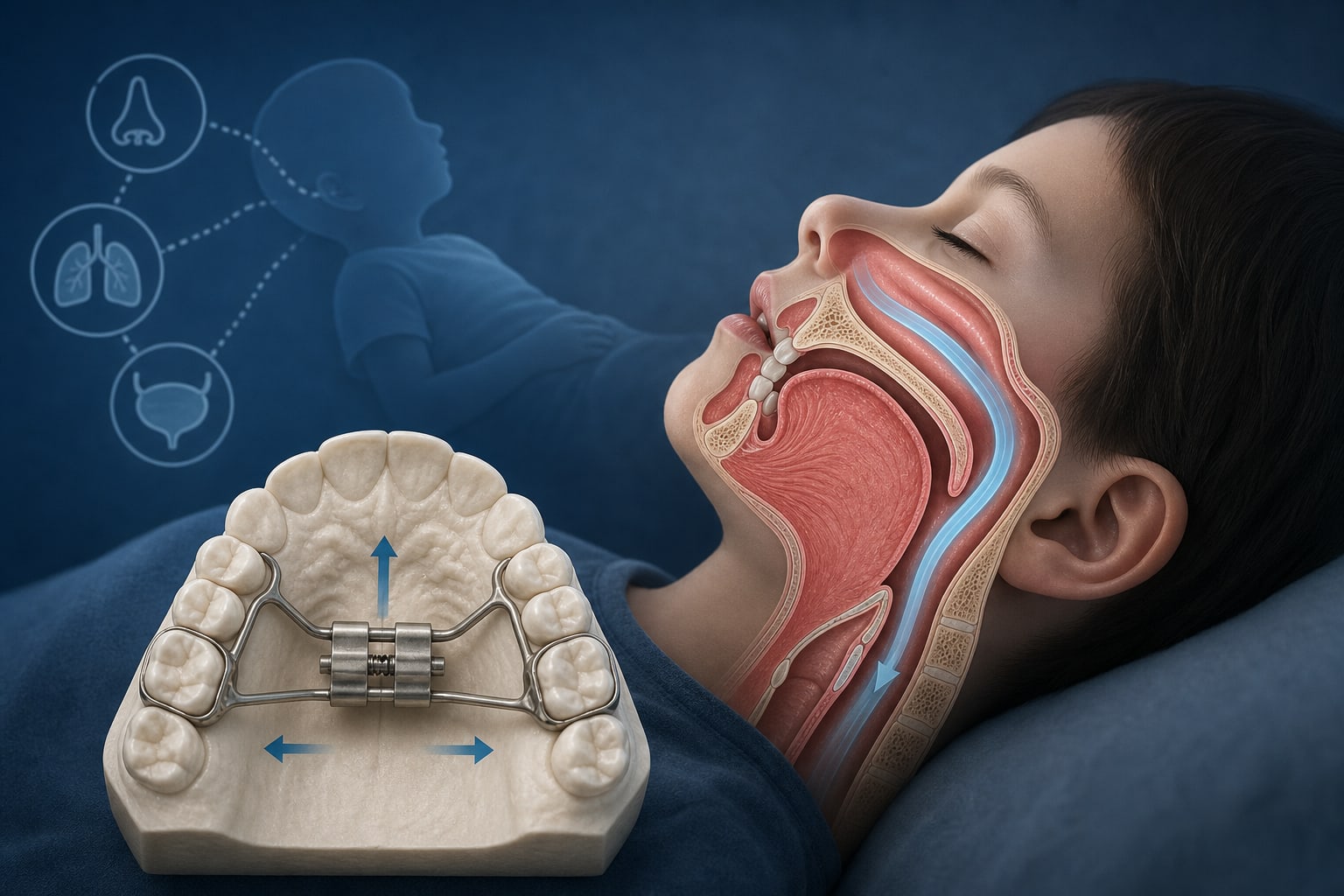
NE is intermittent urinary incontinence during sleep in children aged 5 years or older. Its mechanisms involve nocturnal urine production, reduced bladder capacity or detrusor overactivity, and difficulty awakening to bladder signals. Sleep-disordered breathing may contribute, but most children with NE do not have clinically relevant obstructive sleep apnea (OSA).
Objective
To review medical standards for diagnosing and managing childhood NE and critically examine maxillary expansion as a proposed treatment.
Approach
The authors primarily searched PubMed, using search terms, Boolean operators, and Medical Subject Headings when applicable. They examined historical and contemporary literature on maxillary expansion and NE alongside established medical management.
Data Highlights
NE affects approximately 5% to 10% of 7-year-olds.
The male-to-female ratio is 3:1 and decreases after age 10.
The mean annual spontaneous remission rate is approximately 15%.
Reported alarm therapy success rates are approximately 50% to 70%, with dropout rates of 60% to 80%.
Three systematic reviews were identified; 2 included the same single randomized placebo-controlled trial using a sham maxillary expander.
Key Findings
NE alone does not establish sleep-disordered breathing or indicate a sleep study.
Initial management includes reassurance, motivational strategies, dietary modifications, and constipation treatment.
Alarm therapy is first-line active treatment for appropriately motivated families.
Desmopressin acetate is most effective in children with nocturnal polyuria and normal bladder capacity.
Evidence does not support routine maxillary expansion for NE, particularly without a transverse discrepancy or crossbite.
Interpretation
Poor sleep is one possible contributor to a multifactorial condition. Increasing maxillary width does not directly modify vasopressin secretion, bladder capacity, detrusor activity, or central arousal mechanisms.
Limitations
Studies of maxillary expansion have small, heterogeneous samples, selection bias, inadequate controls or randomization, confounding, and inadequate assessment of sleep-disordered breathing. Inconsistent outcome definitions and limited long-term follow-up hinder evaluation of treatment durability and relapse.
Clinical Implications
Clinicians should assess NE, OSA, and maxillary transverse discrepancy independently. Dental professionals should avoid presenting expansion as a predictable cure for NE and guide families toward appropriate medical assessment. Punishment and shaming should be avoided.
Conclusion
Routine maxillary expansion is not an evidence-based treatment for NE. Management should follow established medical approaches, with referral to pediatricians or pediatric urologists as appropriate.
Related Resources & Content
Nocturnal enuresis and maxillary expansion: A narrative review — Sanjivan Kandasamy and Andrew J. Kirsch — Journal of the American Dental Association — 2026; exact publication date not provided in the supplied PDF.
Management and treatment of nocturnal enuresis: an updated standardization document from the International Children’s Continence Society — T. Nevéus, E. Fonseca, I. Franco, et al. — Journal of Pediatric Urology — 2020;16(1):10-19.
Rapid maxillary expansion in children with nocturnal enuresis: a randomized placebo-controlled trial — I. J. Ring, T. Nevéus, A. Markström, A. Magnuson, and F. Bazargani — The Angle Orthodontist — 2020;90(1):31-38.
Based on findings from:
Nocturnal enuresis and maxillary expansion: A narrative review
Sanjivan Kandasamy, Andrew J. Kirsch. Journal Of The American Dental Association, 2026.
https://jada.ada.org/article/s0002-8177(26)00459-9/fulltext
This content is an AI-generated, fully rewritten summary based on a published scholarly article. It does not reproduce the original text and is not a substitute for the original publication. Readers are encouraged to consult the source for full context, data, and methodology.