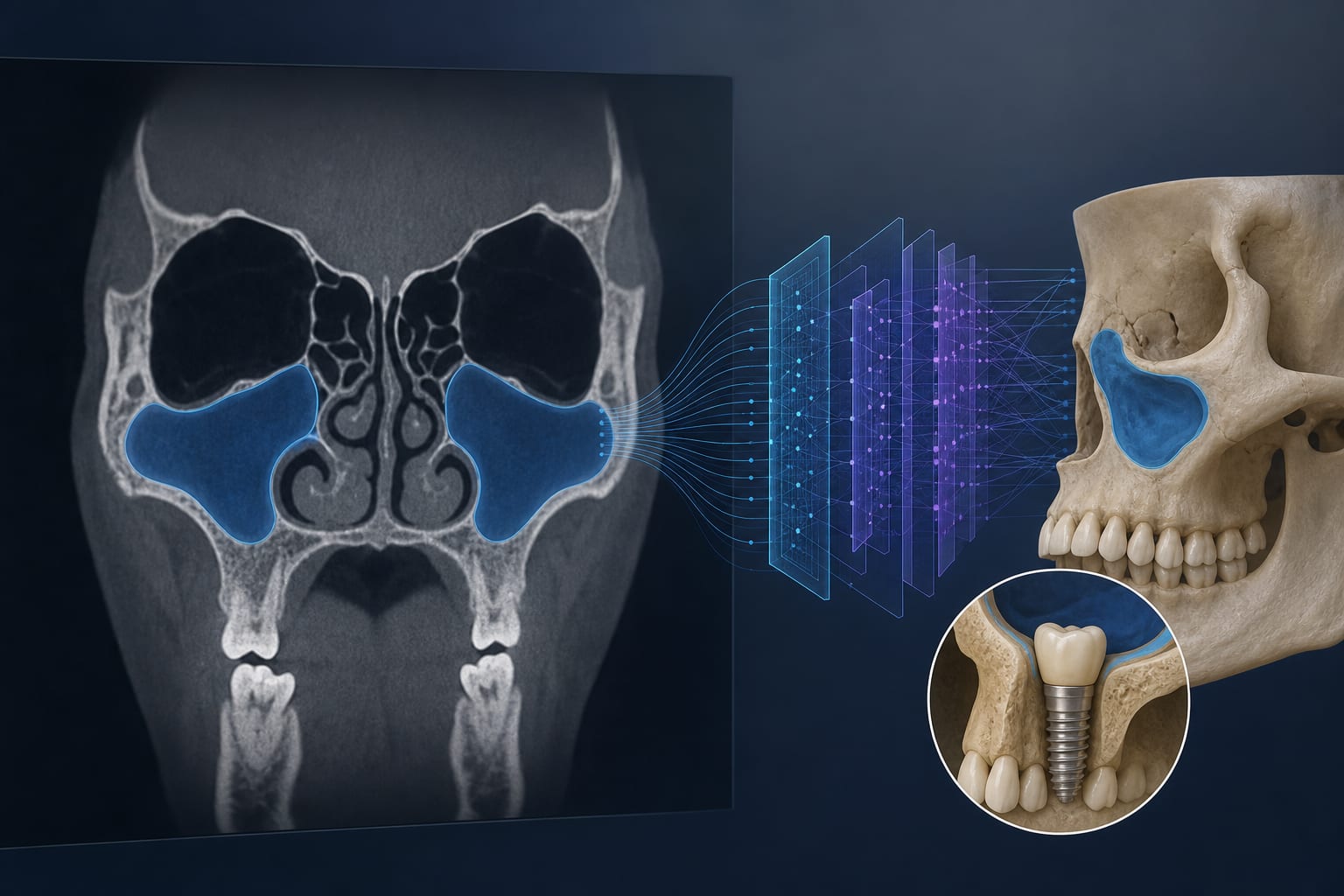
A Brief Review of AI Technology's Role in Maxillary Sinus Segmentation for Dental Applications
-
By
-
Jiayi Chen
-
May 20, 2026
Clinical Report: AI Technology's Role in Maxillary Sinus Segmentation
Overview
This report reviews the application of artificial intelligence (AI) in the segmentation of the maxillary sinus for dental applications, highlighting its potential to enhance diagnostic accuracy and efficiency. The integration of deep learning techniques in imaging analysis may significantly assist dental practitioners in surgical planning and disease diagnosis.
Background
The maxillary sinus plays a crucial role in dental procedures, particularly in implantology and ENT practices. Accurate segmentation of the maxillary sinus on imaging is essential for effective treatment planning and diagnosis. However, traditional manual segmentation methods are time-consuming and prone to observer bias, underscoring the need for advanced technologies like AI to improve clinical outcomes.
Data Highlights
No numerical data available in the source material.
Key Findings
- Deep learning techniques can automate the segmentation of the maxillary sinus, reducing the time and bias associated with manual methods.
- Accurate recognition of the maxillary sinus boundaries is vital for both dental and ENT specialists in surgical procedures.
- Insufficient sample sizes in training datasets can lead to overfitting in deep learning models, affecting diagnostic accuracy.
- AI-assisted imaging can enhance the evaluation of maxillary sinus conditions, aiding in the diagnosis of inflammation and other pathologies.
- Recent studies validate the effectiveness of AI in quantifying bone gain after maxillary sinus augmentation.
Clinical Implications
The integration of AI in maxillary sinus segmentation can streamline the workflow for dental practitioners, allowing for more accurate and efficient treatment planning. Clinicians should consider adopting AI tools to enhance diagnostic capabilities and improve patient outcomes in sinus-related procedures.
Conclusion
AI technology holds significant promise in revolutionizing maxillary sinus segmentation, offering improved accuracy and efficiency in clinical practice. Continued research and development in this area are essential for maximizing its potential benefits in dental applications.
Related Resources & Content
- npj Digital Medicine, 2025 -- Automated Segmentation of Maxillary Sinus and Bone Graft Assessment in CBCT Images Using Deep Learning Techniques
- compendium, 2026 -- Crestal Sinus Lift With Osseodensification in Severely Atrophic Maxilla: Case Series With Long-Term Follow-up
- compendium, 2026 -- The Mainstreaming of AI
- ACR Appropriateness Criteria® Sinonasal Disease: 2021 Update - ScienceDirect
- Clinical outcomes of implants placed with transcrestal maxillary sinus elevation: a systematic review and meta-analysis - ScienceDirect
- Precision of Jaw Computer-Aided Design Models Generated from Ultra-Low MDCT Doses Utilizing ASIR and MBIR Techniques
- ACR Appropriateness Criteria® Sinonasal Disease: 2021 Update - ScienceDirect
- Clinical outcomes of implants placed with transcrestal maxillary sinus elevation: a systematic review and meta-analysis - ScienceDirect
- A deep learning based automated maxillary sinus segmentation and bone grafts analysis in CBCT images | npj Digital Medicine
Based on findings from:
A mini-review on the application of AI technology in the segmentation of maxillary sinus for dentistry
Jiayi Chen. Frontiers In Surgery, 2026.
https://www.frontiersin.org/journals/surgery/articles/10.3389/fsurg.2026.1793412/full
This content is an AI-generated, fully rewritten summary based on a published scholarly article. It does not reproduce the original text and is not a substitute for the original publication. Readers are encouraged to consult the source for full context, data, and methodology.