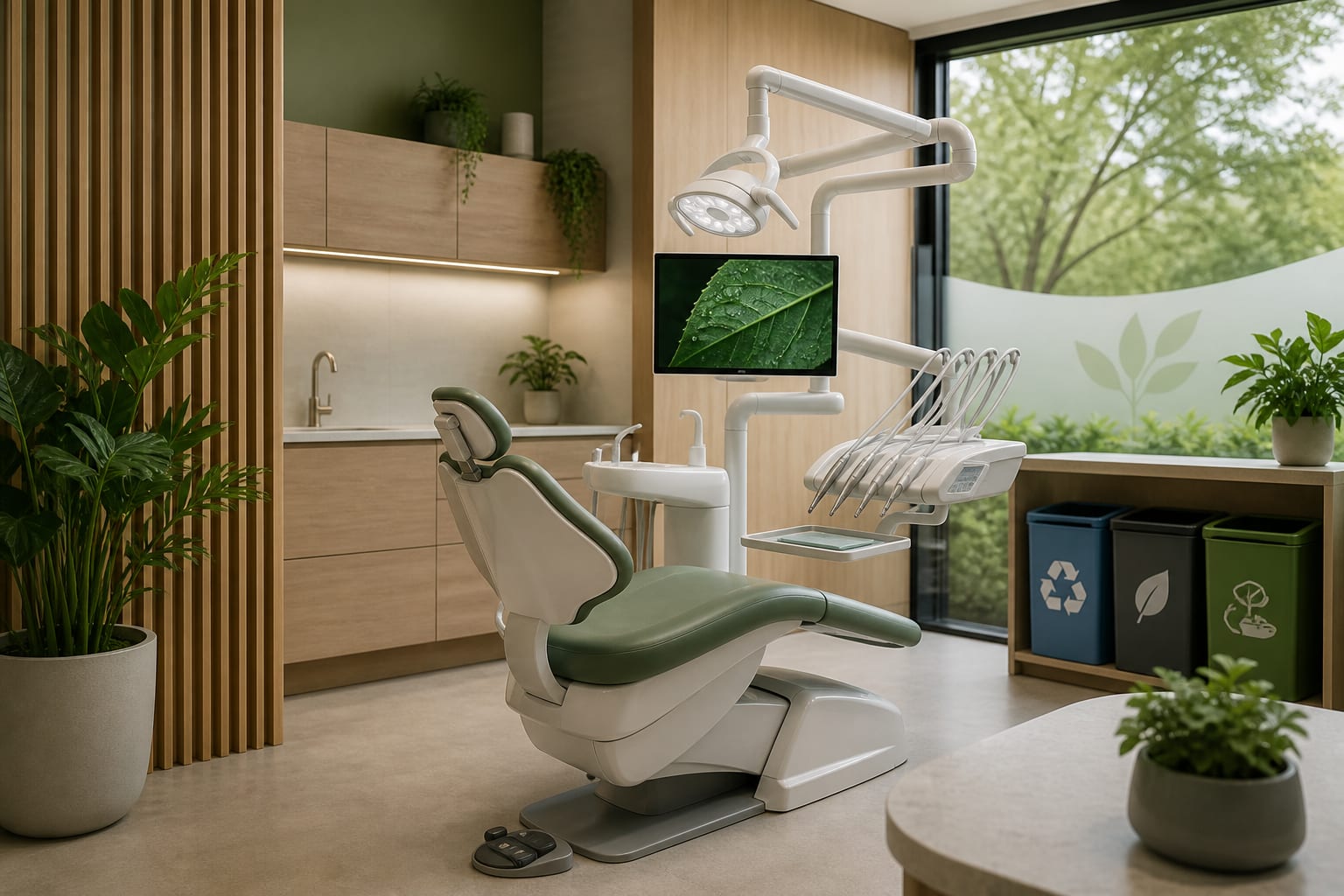
Creating a Sustainable, Environmentally Responsible Dental Practice: Rationale and Practical Steps
-
By
-
Derek Sanders
-
Mark S. Wolff
-
Michael Glick
-
Julian Fisher
-
October 30, 2026
Clinical Scorecard: Creating a Sustainable, Environmentally Responsible Dental Practice: Rationale and Practical Steps
At a Glance
Category | Detail |
|---|---|
Condition | Environmentally responsible, sustainable, and resilient dental practice design and operation |
Key Mechanisms | Emergency preparedness and recovery; planet-centric, prevention-focused care; sustainable resource and waste management; and proactive environmental resilience |
Target Population | Oral health professionals designing, constructing, renovating, or operating general and specialty dental practices |
Care Setting | New and existing dental offices, including clinical operations, facility design, construction, procurement, waste management, and patient-care delivery |
Key Highlights
The article identifies 4 principles for sustainable and resilient practices: emergency preparedness and recovery; planet-centric, prevention-focused care; sustainable resource and waste management; and proactive environmental resilience.
Electronic records, patient portals, digital imaging, and digital intraoral workflows can reduce paper, film, processing chemicals, impression materials, storage needs, transportation, and some clinical waste.
Electronic technologies also consume electricity and create environmental effects through their manufacture and disposal.
Inventory management, reusable products, disinfectable packaging, instrument kits, and waste segregation may reduce waste and operational costs.
US Environmental Protection Agency rule 40 CFR 441 requires dental offices to limit mercury in wastewater through on-site capture and recycling.
Teledentistry may support urgent-care assessment, health-history collection, and treatment follow-up, although it is not appropriate in every circumstance.
Green design may improve indoor air quality, lighting, acoustics, thermal comfort, patient experience, and staff well-being while reducing water and energy consumption.
The article reports that Leadership in Energy and Environmental Design-certified projects use an average of 11% less water and 25% less energy.
Guideline-Based Recommendations
This narrative review discusses evidence- and practice-informed strategies rather than establishing formal clinical guidelines.
Diagnosis
The article does not establish recommendations for diagnosing oral diseases.
Teledentistry may help assess urgent-care needs and identify conditions requiring an in-person consultation, but it is not suitable for every clinical situation.
Management
Incorporate emergency preparedness, disaster response, and recovery into practice design and operations.
Consider electronic health records, patient portals, digital imaging, cloud storage, and digital intraoral workflows to reduce material use and support record recovery after disasters.
Avoid printed models when feasible because their production may involve chemicals and materials that are difficult to recycle.
Apply the waste-management principles of reduce, reuse, recycle, and rethink.
Use inventory controls and consider reusable products, disinfectable packaging, instrument kits, and paper rather than plastic when clinically appropriate.
Separate solid waste for appropriate disposal and recycling whenever possible.
Follow applicable requirements for capturing and recycling mercury from dental wastewater.
Use teledentistry, risk-based recall, coordinated family appointments, consolidated procedures, and maximized care per visit when appropriate to reduce unnecessary travel.
Reduce infection-control waste only when changes do not compromise patient or provider safety.
Monitoring & Follow-up
Consider heat and air-quality surveillance as part of proactive environmental resilience planning.
Use teledentistry for selected treatment follow-up and to identify changes that may require an in-person consultation.
Apply risk-based recall intervals that may be more or less frequent than the traditional 6-month interval according to patient risk.
Evaluate water and energy consumption throughout the facility’s life cycle rather than only during initial construction.
Consider local climate, building orientation, utility costs, plumbing requirements, and available incentives when evaluating infrastructure changes.
Risks
Flooding, rising temperatures, hurricanes, tornadoes, and power interruptions may disrupt dental operations and recovery.
Electronic technologies consume electricity and have environmental effects associated with manufacture and disposal.
Elastomeric impression materials cannot be recycled or broken down in landfills and may release toxic chemicals when incinerated.
Single-use products may support infection control but contribute substantially to waste.
Dental wastewater may contain mercury, microplastics, and nanoplastics that can harm the environment.
Sustainability measures involving infection control must not compromise patient or provider safety.
Just-in-time inventory may reduce stored supplies but can increase deliveries, environmental effects, and financial pressures.
Patient & Prescribing Data
The article addresses patients receiving care in general and specialty dental practices but does not define a disease-specific population or report patient-level clinical or prescribing data.
Its patient-care strategies include prevention-focused care, risk-based recall, teledentistry, coordinated appointments, and consolidation of procedures. These approaches may reduce unnecessary travel, resource-intensive treatment, and frequent visits when clinically appropriate.
Clinical Best Practices
Integrate emergency preparedness, disaster response, and recovery into facility planning and practice management.
Evaluate digital workflows for reductions in paper, imaging materials, impression waste, storage, and transportation while accounting for electricity use and lifecycle effects.
Apply the 4 Rs—reduce, reuse, recycle, and rethink—to procurement and waste-management decisions.
Use inventory controls and select reusable, disinfectable, or lower-impact products when compatible with infection-control requirements.
Segregate waste and comply with requirements governing wastewater mercury capture and recycling.
Consider teledentistry, risk-based recall, and strategic appointment scheduling to reduce unnecessary travel.
Improve indoor environmental quality through appropriate ventilation, filtration, natural lighting, thermal comfort, and acoustic design.
Evaluate water-efficient fixtures, dry or recirculating vacuum pumps, energy-efficient equipment, insulation, light-emitting diode lighting, sensors, and renewable-energy options.
Consider nature-based solutions, smart infrastructure, and heat and air-quality surveillance as components of environmental resilience.
Related Resources & Content
Sanders D, Wolff MS, Glick M, Fisher J. Building an eco-friendly sustainable health care practice: how and why. J Am Dent Assoc. Published online October 30, 2026.
Fisher J, Glick M. Dentistry in a changing world: from inertia to action. Br Dent J. 2025;239(8):559-560.
Antoniadou M. Integrating lean management and circular economy for sustainable dentistry. Sustainability. 2024;16(22):10047.
Khanna SS, Dhaimade PA. Green dentistry: a systematic review of ecological dental practices. Environ Dev Sustain. 2019;21(6):2599-2618.
US Environmental Protection Agency. Technical and Economic Development Document for the Final Effluent Limitations Guidelines and Standards for the Dental Category (40 CFR 441). EPA-821-R-16-005; 2016.
United Nations Environment Programme. Minamata Convention on Mercury: Text and Annexes. Accessed August 19, 2026. https://minamataconvention.org
World Health Organization. WHO Guideline on Environmentally Friendly and Less Invasive Oral Health Care for Preventing and Managing Dental Caries. World Health Organization; 2015.
Guerra M, Morgado M, Leira Y, et al. Integrating sustainability in dentistry: a pathway towards achieving the UN 2030 agenda. Front Oral Health. 2025;6:1549020.
National Research Council. Energy-Efficiency Standards and Green Building Certification Systems Used by the Department of Defense for Military Construction and Major Renovations. National Academies Press; 2013.
US Green Building Council. Benefits of green building. Accessed January 3, 2026. https://www.usgbc.org/press/benefits-of-green-building
US Environmental Protection Agency. WaterSense at Work: laboratory and medical equipment—7.2 vacuum pumps. Published March 2024. Accessed January 4, 2026. https://www.epa.gov/system/files/documents/2024-03/ws-commercial-bmp-watersenseatwork_section7.2_vacuumpumps.pdf
Based on findings from:
Building an eco-friendly sustainable health care practice: How and why
Derek Sanders, Mark S. Wolff, Michael Glick, Julian Fisher. Journal Of The American Dental Association, 2026.
https://jada.ada.org/article/s0002-8177(26)00462-9/fulltext
This content is an AI-generated, fully rewritten summary based on a published scholarly article. It does not reproduce the original text and is not a substitute for the original publication. Readers are encouraged to consult the source for full context, data, and methodology.