A School-Based Teledentistry Model to Improve Oral Health Care Access for People With Autism Spectrum Disorder
-
By
-
Elizabeth Alpert
-
Neeta Chandwani
-
Amy Jiang Lin
-
Sara St. Peter
-
Steven King
-
Manali Raskar
-
Kate Tolland
-
Jane Barrow
-
Christine A. Riedy
-
Inyang Isong
-
October 28, 2026
Clinical Scorecard: A School-Based Teledentistry Model to Improve Oral Health Care Access for People With Autism Spectrum Disorder
At a Glance
Category | Detail |
|---|---|
Condition | Barriers to oral health screening and dental care among children and young adults with autism spectrum disorder |
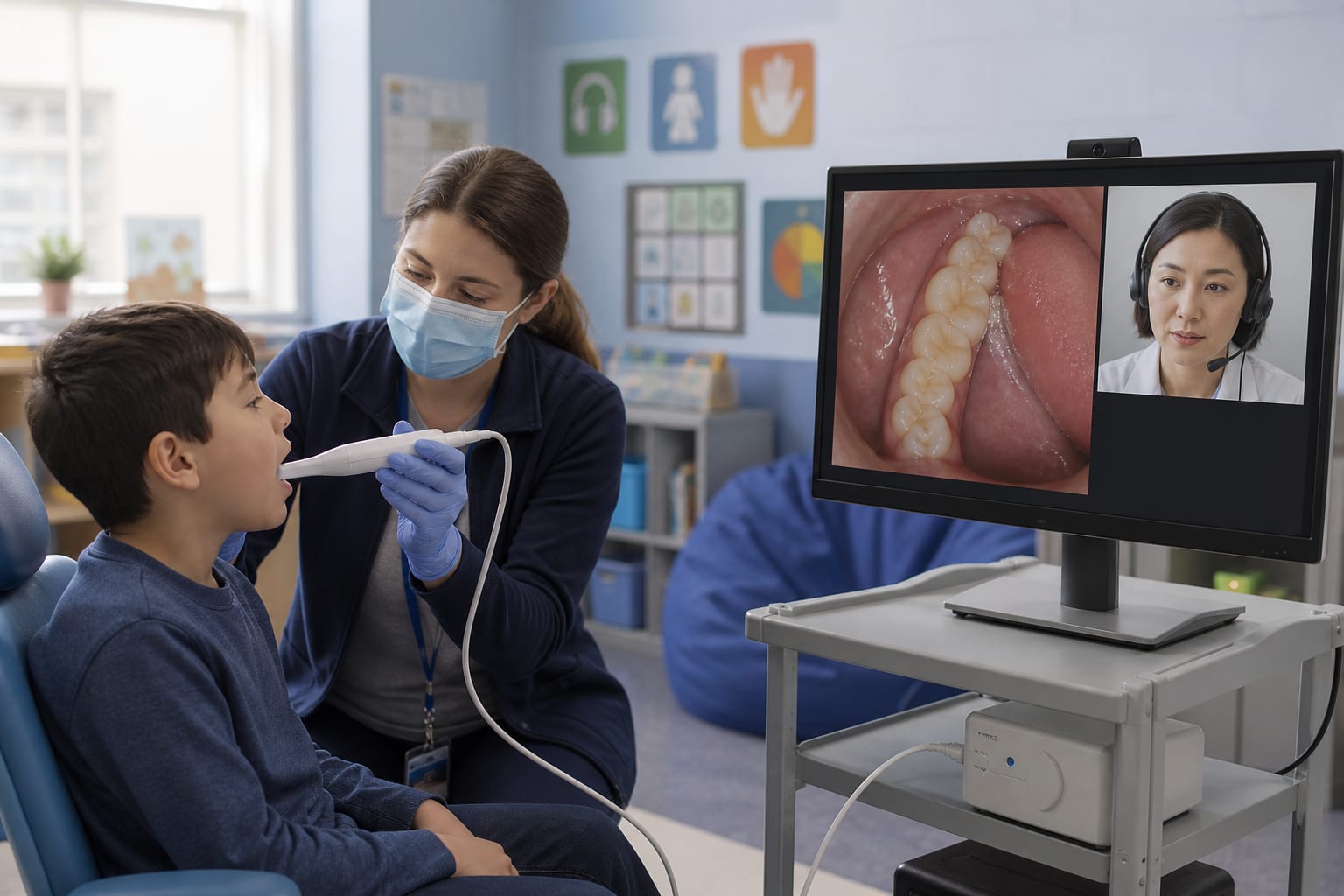
Key Mechanisms | Trained board-certified behavior analysts use individualized desensitization and behavioral support to capture intraoral images; dentists review the images asynchronously and communicate findings, oral health education, and individualized referrals to parents. |
Target Population | Students aged 8 through 21 years with autism spectrum disorder at a Massachusetts special education school that also serves people with other developmental disabilities |
Care Setting | School-based teledentistry in a familiar special education environment, with collaboration among dentists, a pediatrician, school leaders, behavior analysts, parents, and students |
Key Highlights
The model was developed to address sensory challenges, communication differences, competing parent and caregiver priorities, difficulty finding providers, and intolerance of conventional dental visits.
Three board-certified behavior analysts completed 2 90-minute online training sessions covering oral structures and abnormalities, standardized image and video capture, positioning, infection control, privacy, and confidentiality.
The workflow was refined through rapid-cycle quality improvement and consecutive plan-do-study-act cycles.
The pilot included 15 students; 14 (93.3%) were identified as requiring desensitization.
All 15 students tolerated the intraoral-camera encounter well, demonstrated positive behavior, and experienced no adverse events.
Dental concerns were identified in 13 students (86.7%).
Image and video capture took a median of no more than 15 minutes.
Remote dentists reviewed the images and shared findings, oral health education, and individualized referrals with parents.
Guideline-Based Recommendations
This pilot developed and evaluated a workflow; it did not establish formal clinical guidelines or evaluate diagnostic accuracy.
Diagnosis
Board-certified behavior analysts captured intraoral images and videos for asynchronous review by dentists; they did not make dental diagnoses.
Training included recognition of oral structures and potential abnormalities, including caries, gingivitis, and lesions.
Two calibrated dentists independently reviewed the uploaded images, and a third dentist facilitated consensus.
Dental concerns were identified in 13 of 15 students, but the project did not assess the diagnostic accuracy of the screening process.
Management
Behavioral preparation, desensitization, positioning, and image capture were individualized according to each student’s history, needs, assent, and tolerance.
Two behavior analysts per encounter were considered optimal, with separate camera- and computer-operator roles.
Videos were used instead of photographs when movement or difficulty maintaining camera focus affected image capture.
Dentists communicated findings to parents along with oral health education and individualized referrals.
The workflow was intended to support an appropriate referral process and connection to a dental home when needed.
Monitoring & Follow-up
Parent or legally appointed representative consent and participant assent were obtained before participation.
Desensitization requirements varied by student, ranging from 0 to 13 sessions, with a median of 2 and a mean of 2.5.
Flexible preparation and scheduling were necessary because rigid appointment times did not meet the needs of students and behavior analysts.
Quarterly interdisciplinary debriefings and real-time feedback supported continued workflow refinement.
Communication occurred through the electronic dental record, email, and virtual check-ins.
Risks
Sensory challenges, communication differences, caregiver priorities, and difficulty finding dental providers may limit access to conventional care.
Movement, camera focus, excess saliva, positioning, and soft-tissue retraction created image-capture challenges.
Training addressed infection control, confidentiality, and privacy.
No adverse events occurred among the 15 pilot participants.
The small, single-school pilot did not establish diagnostic accuracy, clinical effectiveness, cost-effectiveness, or long-term oral health outcomes.
Patient & Prescribing Data
The pilot included 15 students at Amego School, a year-round Massachusetts special education school serving children and young adults aged 8 through 21 years with autism spectrum disorder and other developmental disabilities.
Fourteen students were identified as requiring desensitization. All 15 tolerated the encounter well and demonstrated positive behavior, 12 reportedly liked the intraoral camera, and behavior analysts were satisfied with image quality for 12 students.
The project evaluated screening, education, and referral rather than medication prescribing or treatment. Findings were reviewed remotely by dentists and shared with parents along with individualized referrals and oral health education.
Clinical Best Practices
Conduct screening in a familiar environment and incorporate it into established behavioral-support frameworks.
Use professionals who have behavioral-management expertise and established relationships with participants.
Individualize desensitization, preparation, positioning, and session timing according to each participant’s assent and tolerance.
Maintain scheduling flexibility rather than relying on rigid appointment times.
Use 2 trained staff members when possible, with separate camera- and computer-operator roles.
Consider video capture when movement or camera-focus problems limit still-image quality.
Calibrate reviewing dentists and use independent review and consensus processes to support consistency.
Obtain appropriate consent and participant assent and protect infection control, confidentiality, and privacy.
Interpret the model as a feasibility and implementation workflow rather than a validated diagnostic pathway.
Related Resources & Content
Alpert E, Chandwani N, Lin AJ, et al. Development of a teledentistry model to facilitate oral health care among people with autism spectrum disorder. JADA Foundational Science. Published online October 28, 2026.
Goyal T, Kalra N, Tyagi R, et al. Evidence-based analysis of multi-pronged approaches for education and behavior management of autistic patients in a dental setting. Spec Care Dentist. 2023;43(6):856-868.
Estai M, Bunt S, Kanagasingam Y, et al. Cost savings from a teledentistry model for school dental screening: an Australian health system perspective. Aust Health Rev. 2018;42(5):482-490.
Howell SEI, Fukuoka B. Teledentistry for patient-centered screening and assessment. Dent Clin North Am. 2022;66(2):195-208.
Goffin G, Carter N, Widyarman AS, et al. Role of teledentistry in enabling improved oral care outcomes. Br Dent J. 2024;236(3):162-168.
Novoa PC, Posse JL, Mato EG, et al. Dental desensitization by dentists and occupational therapists for autistic adults: a pilot study. Autism. 2024;28(2):515-519.
Como DH, Stein Duker LI, Polido JC, et al. Oral health and autism spectrum disorders: a unique collaboration between dentistry and occupational therapy. Int J Environ Res Public Health. 2020;18(1):135.
Ward MM, Bhagianadh D, Ullrich F, et al. Two teledentistry models for the provision of essential oral health care services in rural school settings. J Dent Hyg. 2022;96(6):43-49.
Verma N, Samuel I, Weinreb S, et al. The telemedicine program design canvas: a visual tool for planning telemedicine interventions. Oxf Open Digit Health. 2022;1:oqac002.
Proctor E, Silmere H, Raghavan R, et al. Outcomes for implementation research: conceptual distinctions, measurement challenges, and research agenda. Adm Policy Ment Health. 2011;38(2):65-76.
Based on findings from:
Development of a teledentistry model to facilitate oral health care among people with autism spectrum disorder
Elizabeth Alpert, Neeta Chandwani, Amy Jiang Lin, Sara St. Peter, Steven King, Manali Raskar, Kate Tolland, Jane Barrow, Christine A. Riedy, Inyang Isong. Journal Of The American Dental Association, 2026.
https://jada.ada.org/article/s0002-8177(26)00567-2/fulltext
This content is an AI-generated, fully rewritten summary based on a published scholarly article. It does not reproduce the original text and is not a substitute for the original publication. Readers are encouraged to consult the source for full context, data, and methodology.