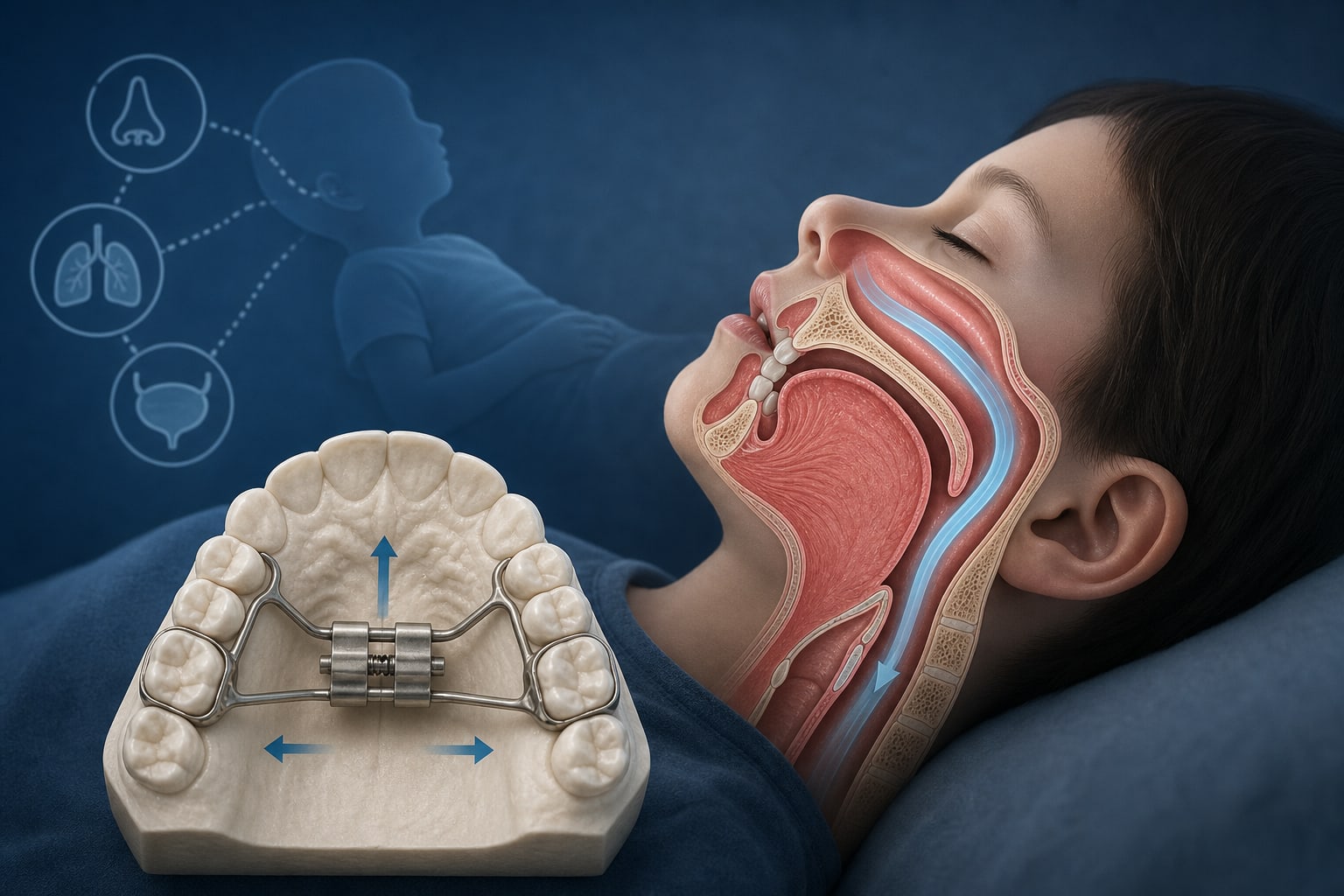
Exploring the Relationship Between Nocturnal Enuresis and Maxillary Expansion: A Comprehensive Review
-
By
-
Sanjivan Kandasamy
-
Andrew J. Kirsch
-
September 29, 2026
Clinical Scorecard: Exploring the Relationship Between Nocturnal Enuresis and Maxillary Expansion: A Comprehensive Review
At a Glance
Category | Detail |
|---|---|
Condition | Nocturnal enuresis (NE) |
Key Mechanisms | Nocturnal urine production, reduced bladder capacity or detrusor overactivity, and difficulty awakening to bladder signals, involving central nervous system signal processing. |
Target Population | Children aged 5 years and older. |
Care Setting | General pediatric and pediatric urology care, with appropriate referrals from dental professionals. |
Key Highlights
NE affects approximately 5% to 10% of 7-year-olds.
Boys are more frequently affected than girls, with a 3:1 ratio that decreases after age 10.
Alarm therapy is first-line active treatment for appropriately motivated families, with reported success rates of approximately 50% to 70%.
Desmopressin acetate is the primary medication used for NE.
Evidence does not support routine maxillary expansion to treat NE.
Guideline-Based Recommendations
Diagnosis
Review medical history, daytime and nighttime urinary symptoms, bowel habits, and sleep symptoms.
Consider a voiding diary; urinalysis and physical examination may also be indicated.
NE alone does not establish sleep-disordered breathing or indicate a sleep study.
Management
Provide reassurance, motivational and reward-based strategies, and dietary modifications, including limiting fluid intake before bedtime.
Identify and treat functional constipation.
Use alarm therapy or medications when initial strategies are ineffective.
Monitoring & Follow-up
Support adherence and assess relapse, which is common during early management.
Alarm therapy requires nightly use for 4 to 6 months; reported dropout rates range from 60% to 80%.
Risks
Untreated NE may impair self-esteem and academic performance and contribute to anxiety, depression, and social isolation.
Unnecessary maxillary expansion may cause unwanted bite changes and dental instability.
Patient & Prescribing Data
Desmopressin acetate reduces urine output and is most effective in children with nocturnal polyuria and normal bladder capacity. Over the long term, alarms are generally more effective and have fewer adverse events than medications.
Clinical Best Practices
Avoid punishment or shaming.
Identify and treat underlying bladder dysfunction before nighttime symptoms in children with nonmonosymptomatic enuresis.
Assess NE, obstructive sleep apnea, and maxillary transverse discrepancy independently.
Do not present maxillary expansion as a predictable cure for NE.
Related Resources & Content
Nocturnal enuresis and maxillary expansion: A narrative review — Sanjivan Kandasamy and Andrew J. Kirsch — Journal of the American Dental Association — 2026
Management and treatment of nocturnal enuresis: an updated standardization document from the International Children’s Continence Society — T. Nevéus, E. Fonseca, I. Franco, et al. — Journal of Pediatric Urology — 2020;16(1):10-19.
Rapid maxillary expansion in children with nocturnal enuresis: a randomized placebo-controlled trial — I. J. Ring, T. Nevéus, A. Markström, A. Magnuson, and F. Bazargani — The Angle Orthodontist — 2020;90(1):31-38.
Based on findings from:
Nocturnal enuresis and maxillary expansion: A narrative review
Sanjivan Kandasamy, Andrew J. Kirsch. Journal Of The American Dental Association, 2026.
https://jada.ada.org/article/s0002-8177(26)00459-9/fulltext
This content is an AI-generated, fully rewritten summary based on a published scholarly article. It does not reproduce the original text and is not a substitute for the original publication. Readers are encouraged to consult the source for full context, data, and methodology.