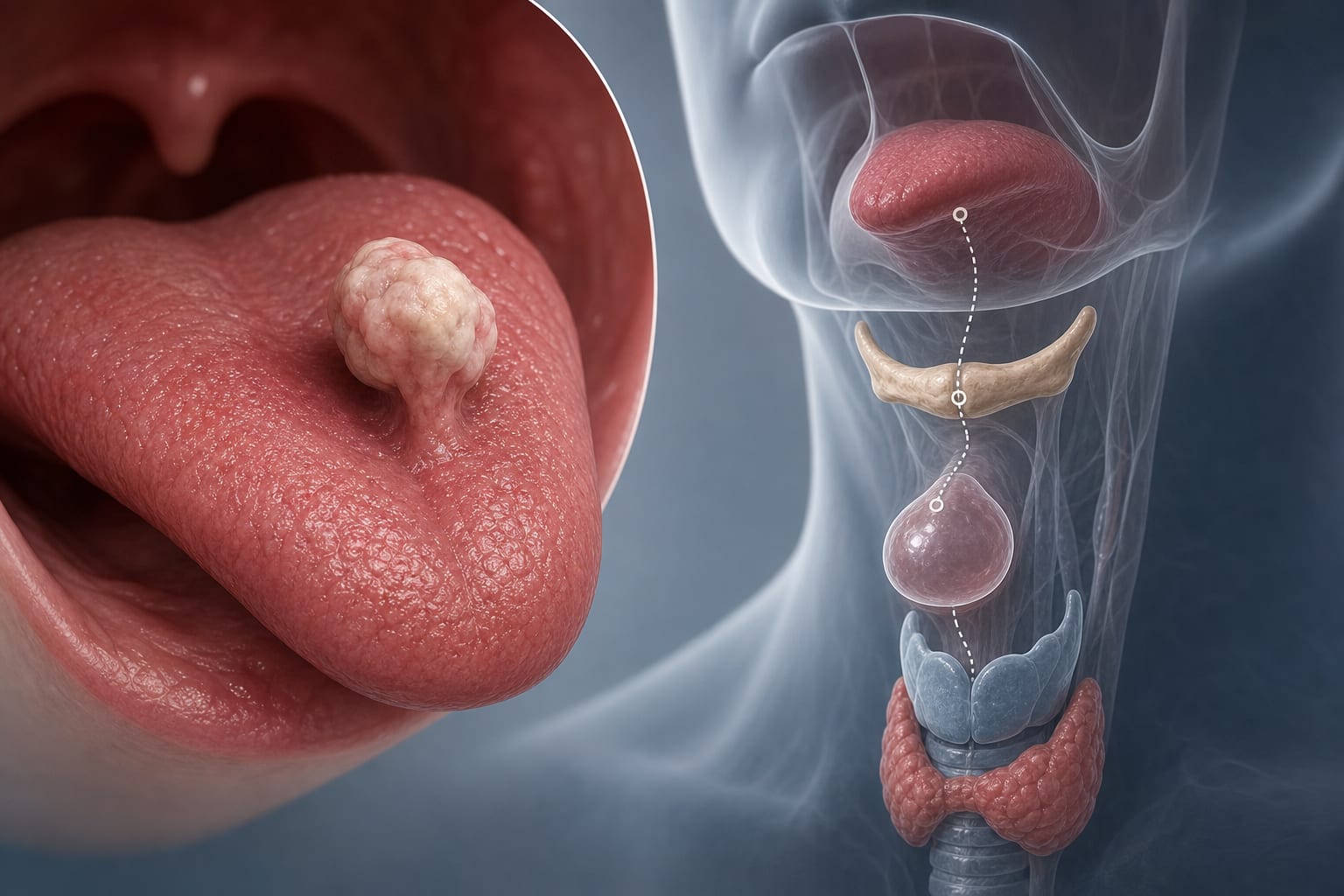
Case Report: Synchronous lingual osseous choristoma and suprahyoid thyroglossal duct cyst: insights into the embryological thyroglossal-hyoid axis - Scorecard - DentalSpire
Advertisement
Case Study: Concurrent Occurrence of Lingual Osseous Choristoma and Suprahyoid Thyroglossal Duct Cyst: Understanding the Embryological Connection of the Thyroglossal-Hyoid Axis
Clinical Scorecard: Case Study: Concurrent Occurrence of Lingual Osseous Choristoma and Suprahyoid Thyroglossal Duct Cyst: Understanding the Embryological Connection of the Thyroglossal-Hyoid Axis
At a Glance
Category
Detail
Condition
Lingual osseous choristoma and thyroglossal duct cyst
Key Mechanisms
Embryological connection along the thyroglossal duct-hyoid axis
Target Population
Young women, particularly those with midline neck masses
Care Setting
Oral and Maxillofacial Surgery
Key Highlights
Lingual osseous choristoma is a rare benign lesion with mature bone tissue in the tongue.
Thyroglossal duct cysts are common congenital lesions resulting from incomplete duct involution.
Synchronous occurrence of both lesions in a single patient is rarely reported.
Imaging and surgical management are crucial for diagnosis and treatment.
Histopathological examination confirmed the diagnoses of both lesions.
Guideline-Based Recommendations
Diagnosis
Use contrast-enhanced MRI for evaluation of suspected thyroglossal duct cysts.
Management
Surgical excision of both the lingual osseous choristoma and thyroglossal duct cyst is recommended.
Monitoring & Follow-up
Long-term follow-up is advised to monitor for recurrence.
Risks
Potential complications include surgical site infection and functional impairment.
Patient & Prescribing Data
26-year-old woman with a posterior tongue mass and dysphagia.
Endoscope-assisted intraoral approach for excision of the lingual mass.
Clinical Best Practices
Consider embryological connections when diagnosing midline neck masses.
Perform thorough imaging of the thyroglossal tract in cases of osseous lesions of the tongue base.
Ensure careful surgical management to avoid complications.