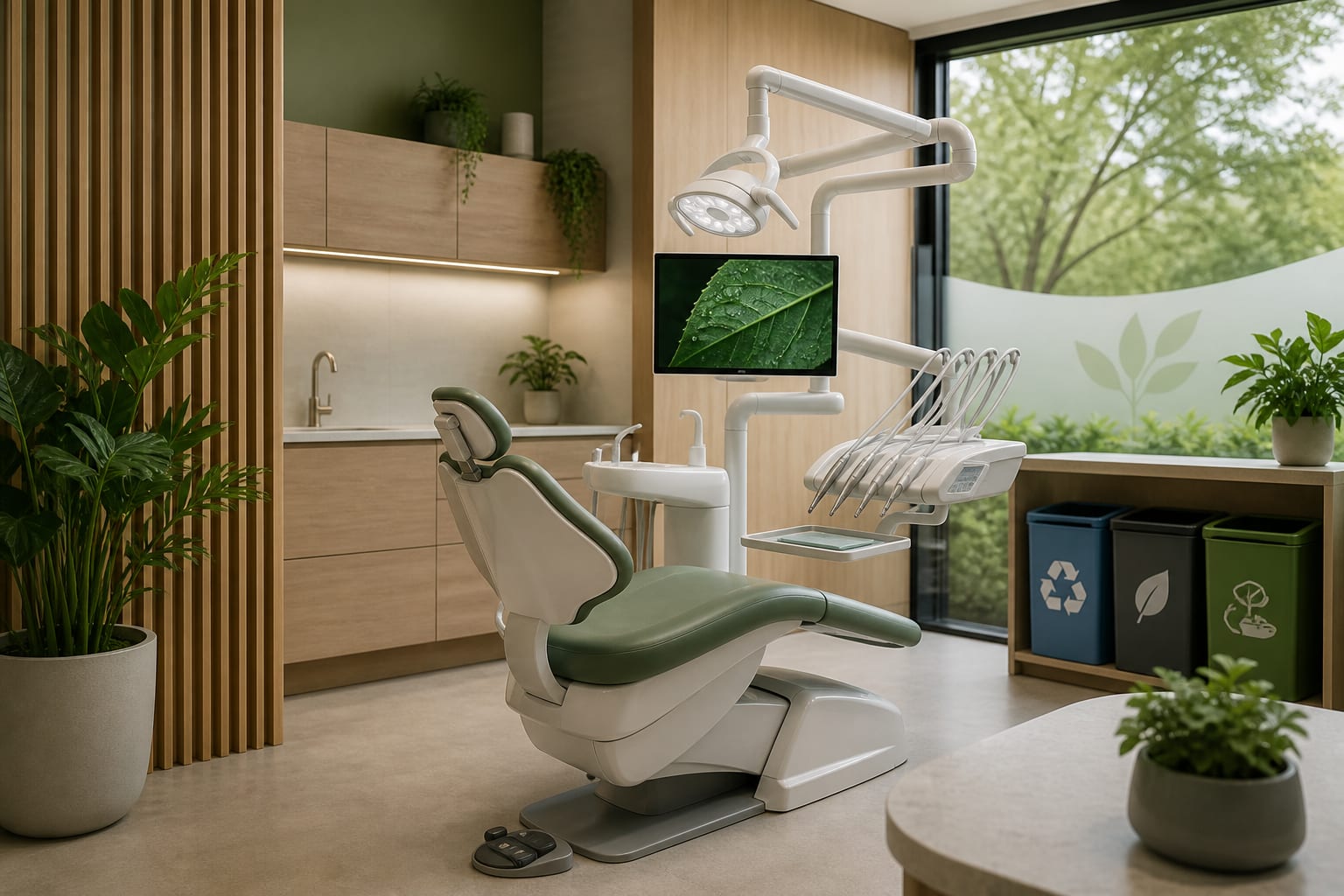
To examine how environmentally responsible office design, facility modifications, and operational changes can strengthen dental practice resilience, reduce environmental effects, and support long-term viability.
Approach:
Evidence Review: This narrative review examines sustainable dental office design, green building strategies, digital workflows, waste management, teledentistry, prevention-focused care, and occupational and environmental health.
Framework: The discussion follows 4 principles: emergency preparedness and recovery; planet-centric, prevention-focused care; sustainable resource and waste management; and proactive environmental adaptation.
Operations: The authors review digital records and imaging, inventory control, reusable materials, waste segregation, mercury capture, teledentistry, and risk-based recall.
Design: Strategies include improved air quality, lighting, and acoustics; reduced water and energy use; renewable energy; and Leadership in Energy and Environmental Design certification.
Key Findings:
Flooding, extreme heat, storms, and power disruptions can interfere with dental operations and recovery.
Digital workflows can reduce paper, film, chemicals, impression materials, waste, and transportation, although electronic technologies also consume energy and create manufacturing and disposal effects.
The waste-management principles of reduce, reuse, recycle, and rethink align with lean-management and circular-economy approaches.
US Environmental Protection Agency rule 40 CFR 441 requires dental offices to limit mercury in wastewater through on-site capture and recycling.
Teledentistry, risk-based recall, consolidated procedures, and coordinated appointments may reduce unnecessary travel.
Green design may improve indoor environmental quality and reduce resource use. The article reports that Leadership in Energy and Environmental Design-certified projects use an average of 11% less water and 25% less energy.
Interpretation:
The article presents environmental sustainability as part of dental practice resilience, encompassing facility design, clinical workflows, resource use, waste management, preparedness, patient experience, staff well-being, and economic viability.
Limitations:
The narrative review does not describe a systematic search, formal study-selection process, or evidence-certainty assessment.
It does not comparatively evaluate a defined sustainability intervention or report original clinical outcomes.
Feasibility varies according to local regulations, climate, infrastructure, utility costs, and available incentives.
Conclusion:
Environmentally responsible design and operations may strengthen dental practice resilience while reducing environmental effects and supporting patient satisfaction, staff well-being, and long-term practice viability.
The judgment stemmed from controlled-substance prescriptions issued after William C. Gardner, DDS, no longer held the state licensure required for federal prescribing authority.