To present a conceptual framework for integrating planetary health considerations alongside established evidence-to-decision factors in the development of clinical and public health oral health guidelines.
Approach:
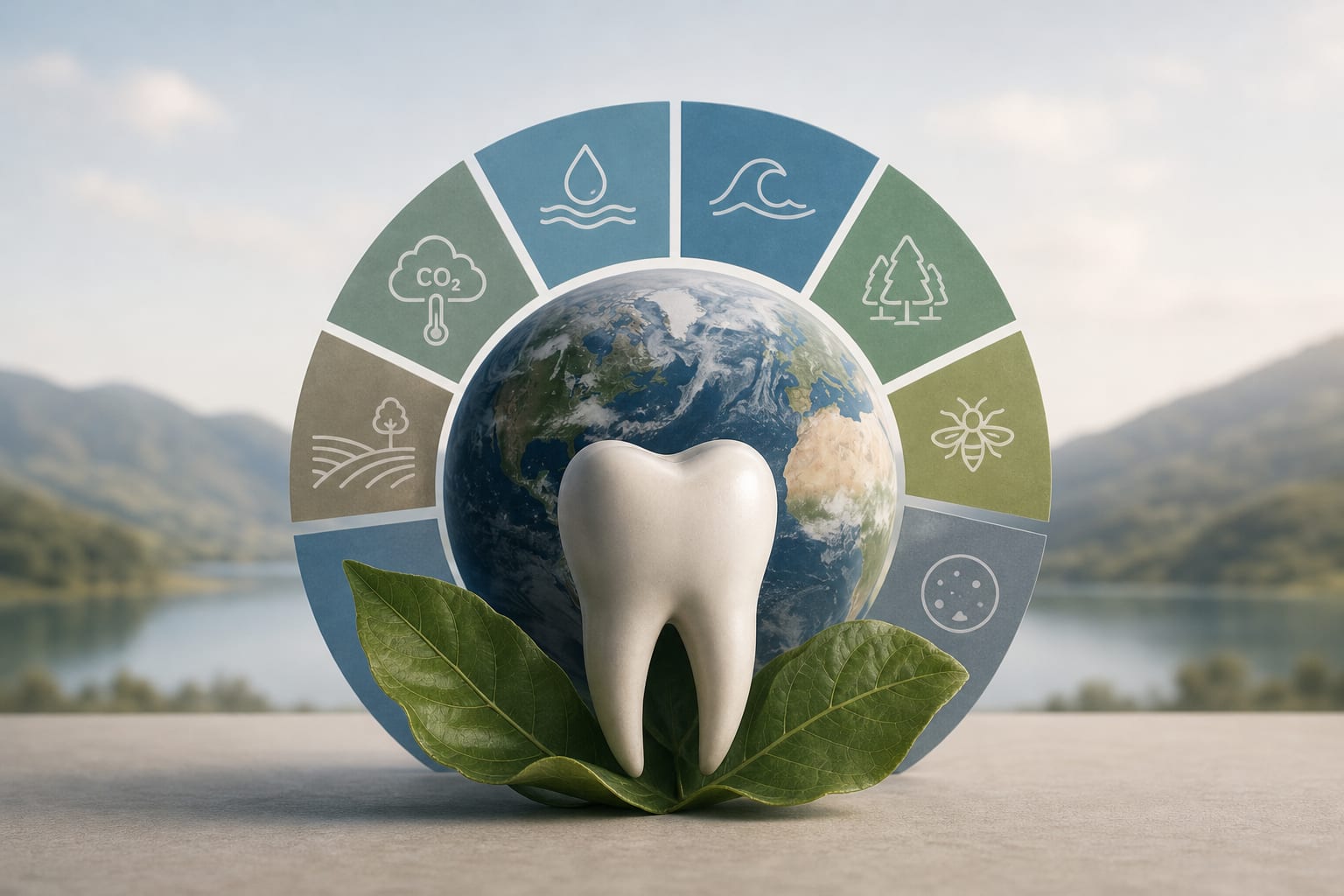
Rationale: The narrative review describes how health care contributes to climate change, pollution, biodiversity loss, and resource depletion and how changes in planetary boundaries can adversely affect human health.
Evidence Base: Drawing on Grading of Recommendations Assessment, Development and Evaluation (GRADE) Guidance 46 and other methodological documents, the authors adapted planetary-health concepts to oral health guideline development.
Oral Health Applications: The framework considers dentistry’s use of energy, water, chemicals, materials, and single-use products, as well as opportunities involving prevention, risk-based recall intervals, minimally invasive care, teledentistry, procurement, and instrument reprocessing.
Environmental Assessment: Life cycle assessment, standardized under International Organization for Standardization standards 14040 and 14044, can quantify environmental effects across products, services, procedures, and clinically appropriate alternatives.
Guideline Process: The framework maps planetary-health considerations across panel composition, question scoping, evidence synthesis, evidence-to-decision judgments, recommendation formulation, implementation, and updating.
Decision Framework: The authors describe 2 complementary GRADE mechanisms: a dedicated planetary-boundaries criterion and a planetary-health subjudgment within the existing equity criterion.
Key Findings:
Guideline panels can explicitly consider environmental effects alongside benefits and harms, certainty of evidence, values, equity, resource use, acceptability, and feasibility.
The planetary-boundaries criterion records the direction and absolute magnitude of effects on relevant boundaries and produces an overall cross-boundary determination.
The planetary-health equity subjudgment addresses effects across species, generations, and people living today, with particular attention to disadvantaged populations.
Life cycle assessments can inform decisions concerning visit frequency, reusable versus single-use pathways, reprocessing, procurement, water and energy consumption, waste, and greenhouse gas emissions.
Prevention-focused care, risk-based recall intervals, minimally invasive approaches, and teledentistry may reduce travel, consumable use, and energy demands without compromising clinical outcomes when the available evidence supports clinically comparable options.
When environmental evidence was not sought, is unavailable, or does not demonstrate a meaningful difference, panels should document that judgment transparently rather than leave the environmental domain unaddressed.
Environmental considerations should not override infection prevention and control, clinical effectiveness and safety, patient autonomy, or equitable access to care.
Interpretation:
The proposed framework extends established guideline methods by making environmental evidence, its certainty, and associated trade-offs visible to guideline panels and users. It offers a structured way to incorporate planetary health when clinically appropriate options differ in environmental footprint. The authors present the framework as a conceptual contribution to an evolving methodological discussion rather than a settled protocol.
Limitations:
The article is a narrative review presenting a conceptual framework rather than an empirical evaluation of its implementation or effects.
Many dental interventions lack life cycle assessments, and existing assessments may not generalize across settings with different energy systems, waste practices, and procurement processes.
No single validated tool exists specifically for assessing the risk of bias or certainty of a body of life cycle assessment evidence used in guidelines.
Environmental evidence may rely on modeled or context-specific data, complicating judgments about indirectness, inconsistency, and imprecision.
The guideline community has not reached consensus on how planetary-health considerations should be integrated systematically.
The framework does not prescribe how panels should balance human-health outcomes against planetary considerations when they conflict.
Conclusion:
Incorporating planetary-health considerations into oral health guideline development is feasible and warranted as a conceptual contribution to an evolving methodological field. Existing decision frameworks can accommodate a concise environmental lens when clinically comparable options have different environmental effects. Transparent use of life cycle assessments and explicit consideration of planetary boundaries may help panels address environmental benefits, trade-offs, equity, and implementation without compromising infection prevention, effectiveness, safety, or patient care.
The company is offering veterans free enrollment in the Aspen Dental Savings Plan during November and expanding benefits through its relationship with the Veterans of Foreign Wars.