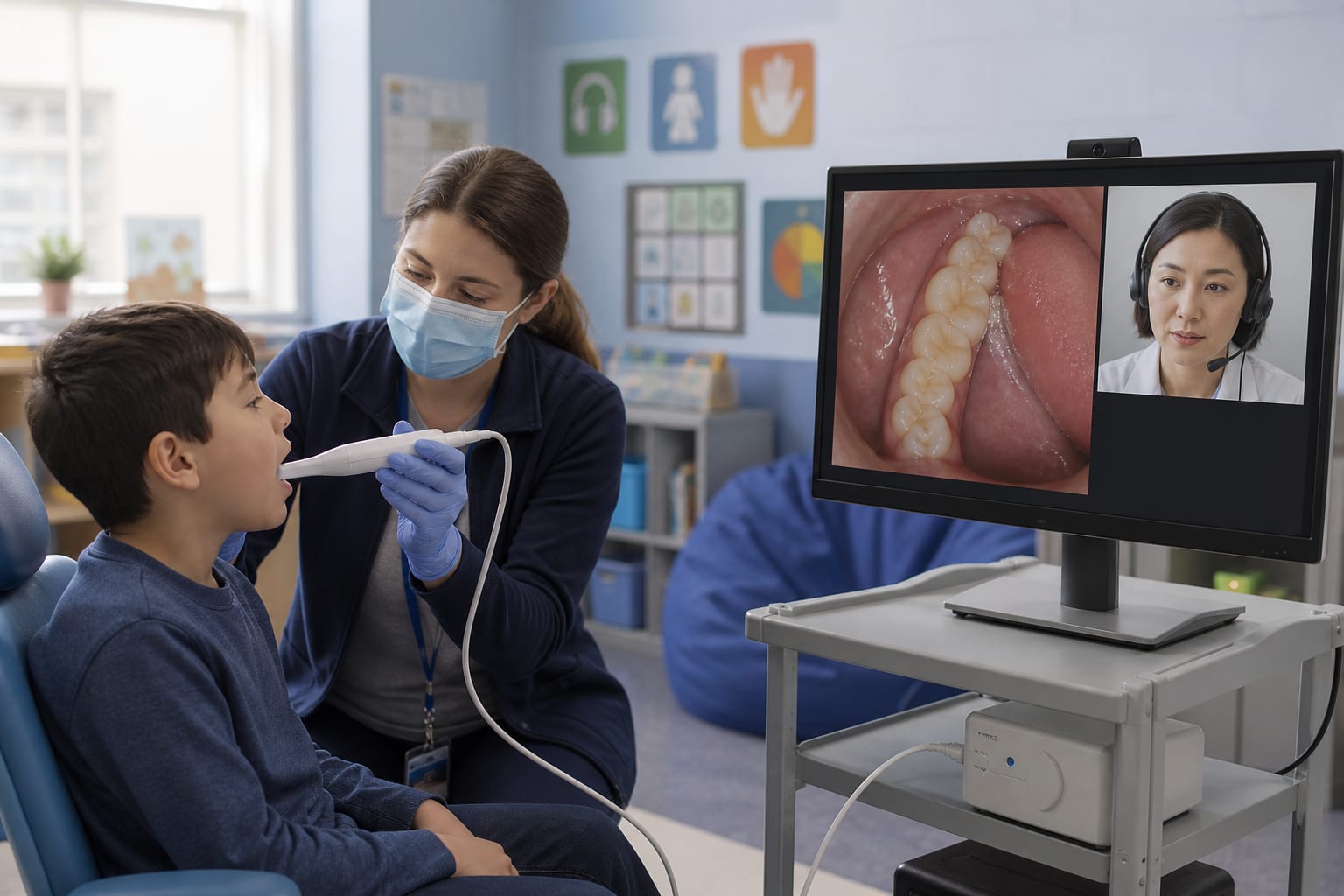
To develop and refine a school-based teledentistry workflow in which trained board-certified behavior analysts (BCBAs) capture intraoral images for asynchronous dental screening of students with autism spectrum disorder (ASD), and to assess its feasibility and implementation.
Approach:
Setting and Team: The project was conducted at Amego School, a year-round Massachusetts special education school serving students aged 8 through 21 years with ASD and other developmental disabilities. The team included dentists, a pediatrician, school leaders, BCBAs, parents, and students.
Training and Workflow: Three BCBAs completed 2 90-minute online training sessions covering oral structures and abnormalities, standardized image and video capture, positioning, infection control, privacy, and confidentiality. Remote dentists reviewed uploaded images asynchronously, and findings were shared with parents along with oral health education and individualized referrals.
Behavioral Support: BCBAs used individualized desensitization, existing therapeutic relationships, and familiar school environments to prepare students for image capture. Parent or legally appointed representative consent and student assent were obtained.
Process Refinement: Rapid-cycle quality improvement and consecutive plan-do-study-act cycles addressed skill acquisition, desensitization, image optimization, calibration, scheduling, and workflow consistency.
Evaluation: Feasibility and implementation were assessed using metrics aligned with Proctor’s Implementation Outcome Framework, including acceptability, adoption, appropriateness, feasibility, fidelity, cost, penetration, and sustainability.
Key Findings:
The pilot included 15 students; 14 (93.3%) were identified by BCBAs as needing desensitization.
All 15 students tolerated the intraoral-camera encounter well, demonstrated positive behavior during the encounter, and experienced no adverse events.
BCBAs reported that 12 students (80%) liked the intraoral camera and expressed satisfaction with final image quality for 12 students (80%).
Image and video capture took a median of no more than 15 minutes. Desensitization sessions ranged from 0 to 13 per student, with a median of 2 and a mean of 2.5.
Dental concerns were identified in 13 students (86.7%).
Two BCBAs per encounter were considered optimal, with separate camera- and computer-operator roles. Videos were used instead of photographs when camera focus and student movement created difficulties.
Two calibrated dentists independently reviewed images, and a third dentist facilitated consensus.
The workflow was modified continuously according to student tolerance, BCBA practices, school schedules, and interdisciplinary feedback.
Interpretation:
The project demonstrates the feasibility of incorporating trained nondental professionals with behavioral-management expertise into a school-based teledentistry workflow for students with ASD. Familiar settings, individualized desensitization, flexible scheduling, and asynchronous dentist review supported implementation. The findings evaluate workflow feasibility and implementation rather than diagnostic accuracy or clinical effectiveness.
Limitations:
The pilot involved only 15 students at a single special education school.
Several outcomes, including tolerance, behavior, camera acceptance, and image-quality satisfaction, were reported by BCBAs.
The project did not evaluate diagnostic accuracy, clinical effectiveness, or long-term oral health outcomes.
Dentists volunteered their time, screenings were free, and the pilot received 1 year of grant funding; cost-effectiveness was not established.
Application in other settings may depend on staff roles, daily involvement with participants, individual support needs, facility characteristics, and access to dental consultation.
Conclusion:
An interdisciplinary team developed a feasible school-based teledentistry workflow in which trained BCBAs used behavioral strategies to capture intraoral images for remote dentist review. The model identified unmet dental concerns, supported referrals to dental homes, and may help reduce barriers for people with ASD who have difficulty tolerating conventional dental visits. Further research is needed to evaluate clinical effectiveness and implementation in other settings.
by Elizabeth Alpert, Neeta Chandwani, Amy Jiang Lin, Sara St. Peter, Steven King, Manali Raskar, Kate Tolland, Jane Barrow, Christine A. Riedy, Inyang Isong
The 5-year commitment to the American Association of Orthodontists Foundation is aimed at advancing and helping shape the future of the orthodontic specialty.