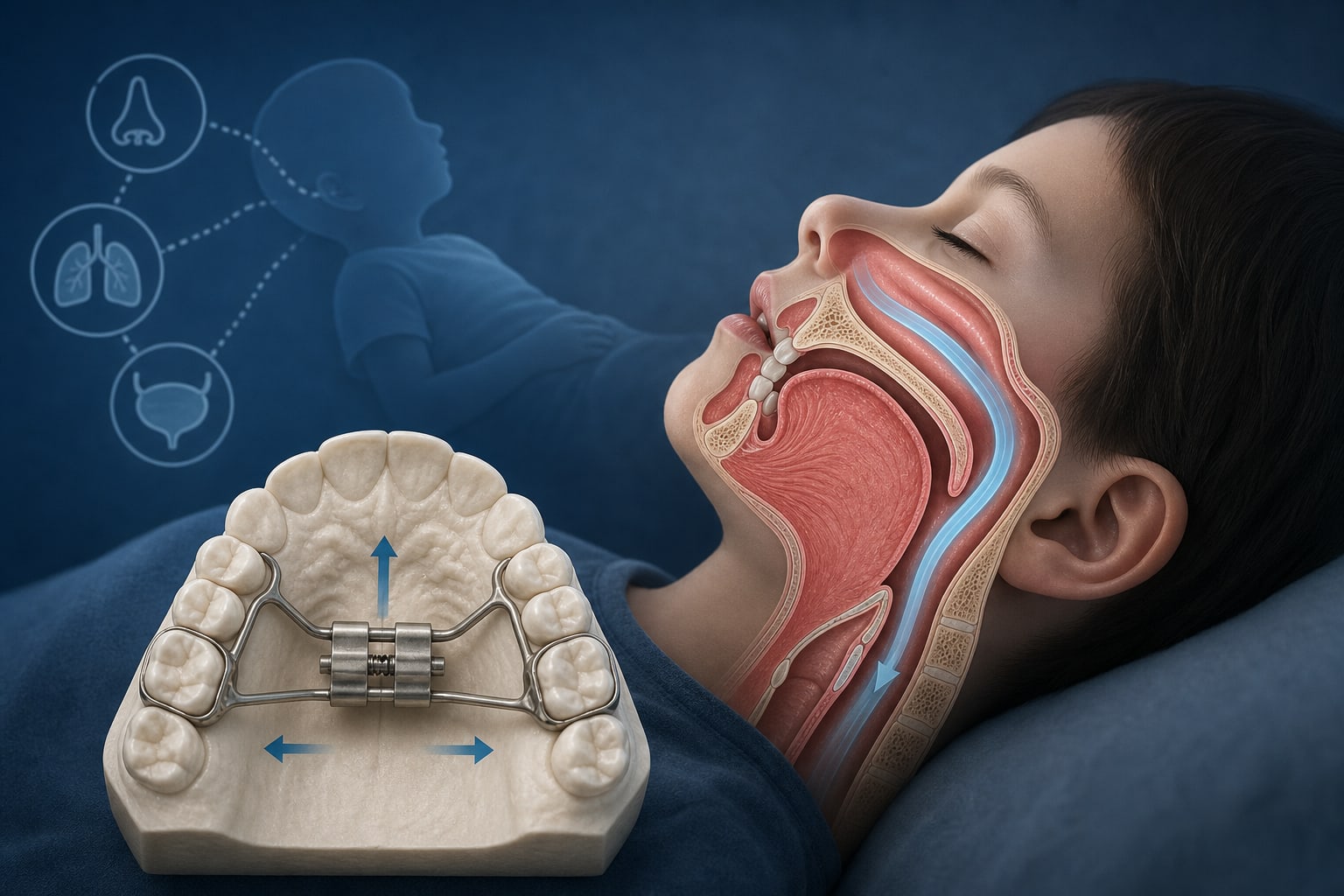
To review nocturnal enuresis (NE), established standards for its diagnosis and management in children, and the evidence concerning maxillary expansion as a treatment for NE associated with sleep-disordered breathing (SDB).
Approach:
Definition and Prevalence: NE is intermittent urinary incontinence during sleep in children aged 5 years or older, affecting approximately 5% to 10% of 7-year-olds.
Pathophysiology: The review examines nocturnal urine production, reduced bladder capacity or detrusor overactivity, and impaired awakening, with central nervous system signal processing underlying these mechanisms.
History and Examination: Evaluation includes medical history, daytime and nighttime urinary symptoms, bowel habits, and sleep symptoms. A voiding diary, urinalysis, and physical examination may be indicated.
Management: The authors review reassurance, behavioral strategies, fluid and dietary modifications, constipation treatment, alarms, and desmopressin acetate. Literature searches primarily used PubMed to examine maxillary expansion.
Key Findings:
Three systematic reviews were identified; 2 included the same single randomized placebo-controlled trial using a sham maxillary expander.
Alarm therapy is first-line active treatment for appropriately motivated families, with reported success rates of approximately 50% to 70% and dropout rates of 60% to 80%.
Most children with NE do not have clinically relevant obstructive sleep apnea (OSA). NE alone neither establishes SDB nor indicates a sleep study.
The authors conclude that maxillary expansion is not an evidence-based treatment for NE. Expansion without a transverse discrepancy or crossbite is unsupported.
Interpretation:
Poor sleep may contribute to NE, but it is only one factor in a multifactorial condition. NE, OSA, and maxillary transverse discrepancy should be assessed independently.
Limitations:
Evidence on maxillary expansion includes small, heterogeneous samples, selection bias, inadequate controls or randomization, confounding, and inadequate SDB diagnosis.
Inconsistent outcome definitions and limited long-term follow-up hinder assessment of treatment durability and relapse.
Conclusion:
Routine maxillary expansion for NE is unsupported. Dental professionals should explain established management approaches and direct families to appropriate medical care, including pediatricians or pediatric urologists.
The company is offering veterans free enrollment in the Aspen Dental Savings Plan during November and expanding benefits through its relationship with the Veterans of Foreign Wars.