The article examines the objective, findings, and clinical context described in ROE Dental Laboratory Introduces ArchBridge Digital Overdenture System.
Approach:
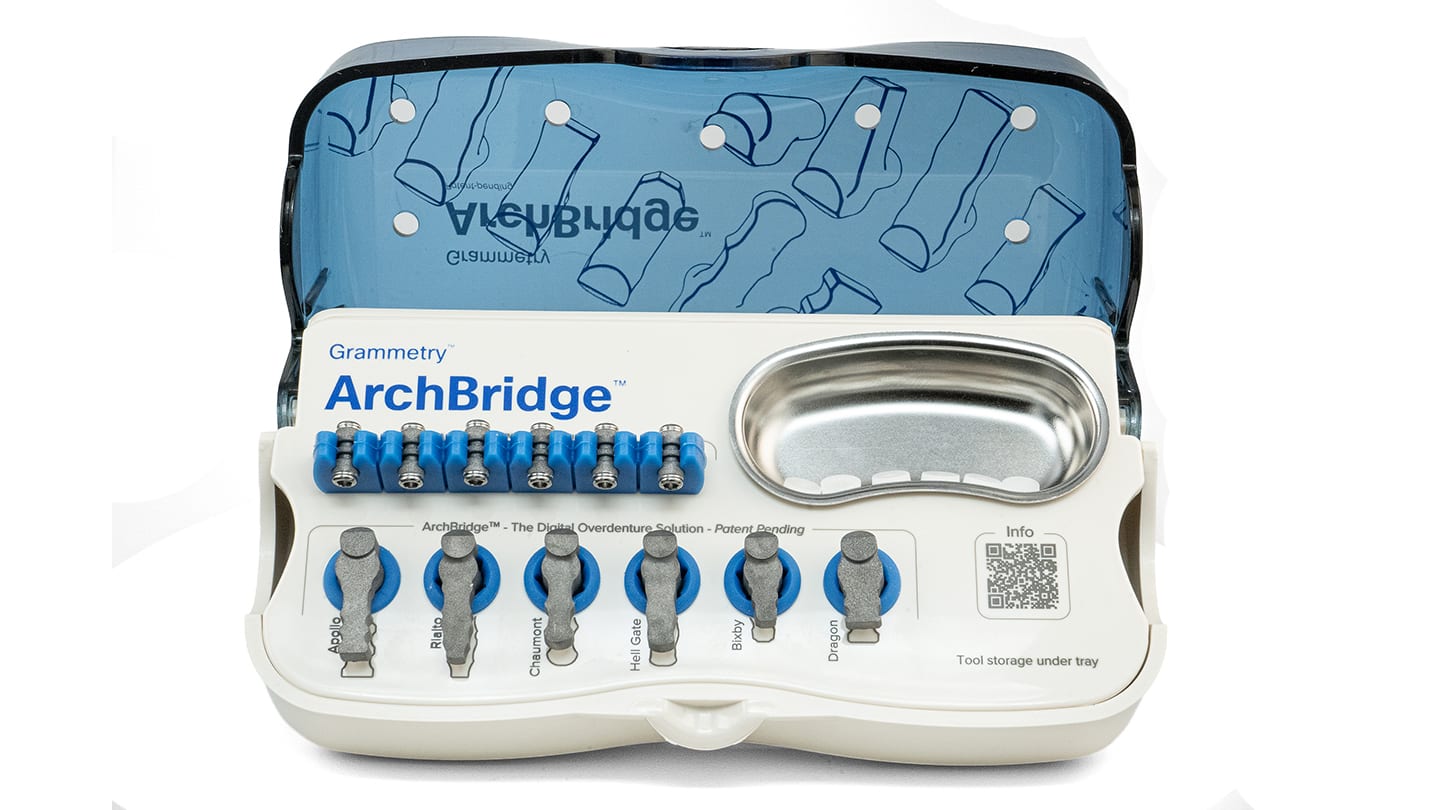
Scanning system: ArchBridge uses six reusable titanium scan bodies that press-fit onto overdenture abutments. Their distinct geometries provide reference points for intraoral scanning; tactile seating supports placement confirmation, and sandblasted surfaces are intended to re…
Laboratory workflow: ROE says clinicians scan and send records to the laboratory, where overdenture housings are positioned and cured before delivery. The workflow eliminates poured models and analogs for attachment positioning and replaces chairside blockout and intraoral acrylic…
Applications and availability: The company says the system is compatible with most major overdenture systems and supports replacement overdentures, conversion of healing dentures, and conversion of removable overdentures to fixed hybrid restorations. Kits are available now.
Key Findings:
ArchBridge is a patent-pending digital scanning system and workflow for fixed and removable overdenture cases.
ROE states that laboratory placement and curing of housings is intended to address potential binding or spacer movement during curing.
The kit includes spacers and placement tools; scan bodies can be autoclaved between patients.
Interpretation:
The article describes a company-introduced dental laboratory workflow and its intended features; it does not report clinical study results.
Limitations:
Product capabilities and intended benefits are reported by ROE Dental Laboratory.
The article provides no comparative clinical or workflow data.