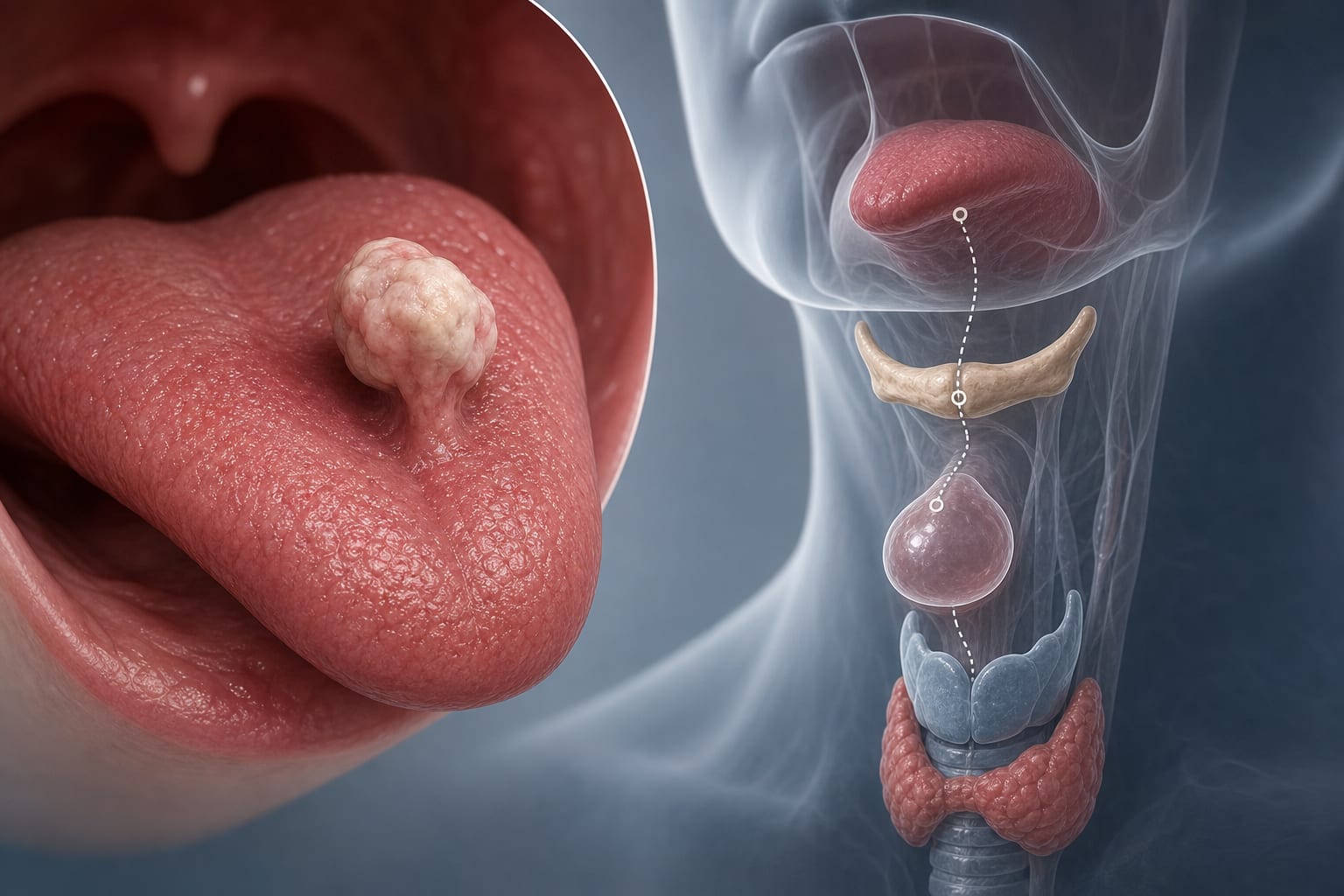
Case Report: Synchronous lingual osseous choristoma and suprahyoid thyroglossal duct cyst: insights into the embryological thyroglossal-hyoid axis - Summary - DentalSpire
Advertisement
Case Study: Concurrent Occurrence of Lingual Osseous Choristoma and Suprahyoid Thyroglossal Duct Cyst: Understanding the Embryological Connection of the Thyroglossal-Hyoid Axis
To report a rare case of concurrent lingual osseous choristoma and suprahyoid thyroglossal duct cyst and explore their potential embryological connection.
Approach:
Patient Presentation: A 26-year-old woman presented with a posterior tongue mass and foreign-body sensation during swallowing.
Imaging and Diagnosis: Contrast-enhanced MRI revealed a cystic lesion suggestive of a suprahyoid TGDC, and histopathological examination confirmed the diagnoses.
Surgical Management: The lingual mass was excised endoscopically, followed by transcervical excision of the TGDC and partial resection of the hyoid bone.
Key Findings:
Lingual osseous choristoma is a rare benign lesion with mature bone tissue in the tongue.
Thyroglossal duct cysts are common congenital neck lesions due to incomplete involution of the thyroglossal duct.
Interpretation:
The synchronous occurrence of these lesions may indicate a dual manifestation of residual mesenchymal tissue along the embryological axis.
Limitations:
The rarity of concurrent occurrences limits broader generalizations.
Conclusion:
The findings highlight the importance of thorough imaging of the thyroglossal tract when encountering osseous lesions.