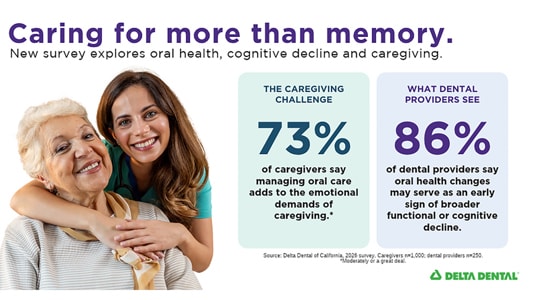
Assess awareness of a possible relationship between oral health and cognitive decline, and identify oral-care challenges reported by older adults, caregivers, and dental providers.
Approach:
Survey: Delta Dental Insurance Company’s 2026 Cognitive Decline and Oral Health Survey gathered perspectives from older adults, caregivers, and dental providers.
Key Findings:
Among adults aged 65 and older, 62% were unaware of a possible connection between oral and cognitive health. While 81% said oral health meaningfully affects quality of life, 38% had heard that bacteria from the mouth could travel to the brain and contribute to inflammation associated with cognitive decline.
Thirty percent of older adults believed poor oral health might increase Alzheimer’s disease risk; 83% wanted more research on the possible relationship, and 82% said they would prioritize oral healthcare more after learning about it.
Among caregivers, 63% were unsure whether they provided oral care correctly, 76% wanted clearer guidance, and 79% wanted advice or resources from dental providers. Sixty-three percent sometimes or often delayed or skipped brushing or flossing because of competing responsibilities.
Ninety percent of caregivers said maintaining a loved one’s oral health helped preserve dignity and quality of life.
Among dental providers, 82% had treated a patient experiencing cognitive decline in the previous month, and 86% believed oral health changes could be an early indication of broader cognitive decline. Seventy-two percent reported screening for cognitive changes through patient health histories, while 78% felt more confident addressing oral health concerns associated with physical aging than those related to cognitive decline.
Interpretation:
Delta Dental said the findings point to opportunities for dental professionals to offer caregivers more guidance and include discussions of cognitive changes in oral-care planning for older adults.
Limitations:
The survey reports respondents’ awareness, beliefs, and experiences; the context does not establish a causal relationship between oral health and cognitive decline.
Conclusion:
Delta Dental encourages communication among dental providers, older adults, and caregivers about difficulties maintaining daily oral hygiene and ways to support oral health as care needs change.
Research highlights expanding diagnostic capabilities but persistent gaps in antiviral therapy and vaccine coverage for pediatric enterovirus infections.