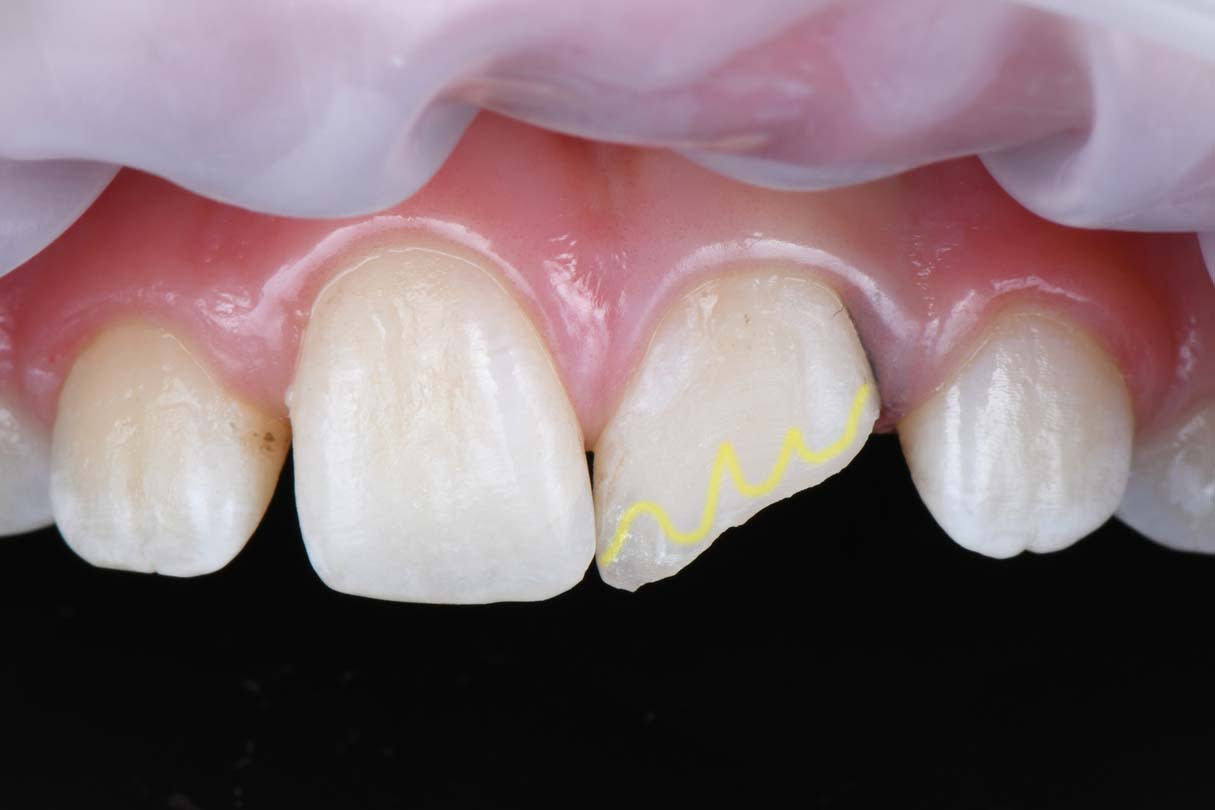
To describe the restoration of a fractured maxillary left central incisor in a pediatric patient using a layered direct composite technique.
Approach:
Patient Evaluation: A 9-year-old patient was evaluated following emergency treatment for a fractured maxillary left central incisor. Initial records included clinical photography, radiographs, and an intraoral digital scan. Evaluation of black and white photographs revealed lower value in the gingival one half of the tooth, raising the possibility of early pulpal degradation.
Restorative Planning: A conservative direct composite restoration was planned after an endodontic assessment indicated that root canal therapy was not needed at this time, although it might be required in the future.
Composite Application: The previous composite build-up was removed, and the facial surface was beveled in three planes to maximize the bonding surface area and facilitate a seamless blend with the natural tooth structure. A silicone stent fabricated from the wax-up guided initial lingual enamel placement with composite shade WE (CLEARFIL MAJESTY® ES-2, Kuraray Dental, kuraraydental.com). Layers of A1 dentin (CLEARFIL MAJESTY ES-2) were applied and mamelons were carefully sculpted to recreate natural incisal anatomy. Facial enamel shade WE was then layered over the dentin.
Finishing and Polishing: Finishing included the use of red articulating paper to map and refine microanatomy. Final polish was completed with a featherlight gray polisher.
Key Findings:
The layered composite technique using CLEARFIL MAJESTY® ES-2 allows for precise recreation of incisal anatomy, mamelons, and natural translucency.
A silicone stent provides a reliable scaffold for enamel placement, ensuring accurate tooth contour and proper incisal length from the outset.
Three-plane beveling that combines a 45-degree bevel, scalloped bevel, and infinite bevel maximizes bonding surface area and creates invisible margins that blend seamlessly with surrounding natural enamel.
Interpretation:
The technique delivers esthetic outcomes comparable to indirect restorations.
Conclusion:
The layered direct composite technique effectively restored the fractured tooth, preparing the patient for orthodontic treatment.
New PNAS study using Wisconsin cohort data finds no negative association between community water fluoridation and adolescent IQ or cognitive performance across the life course.