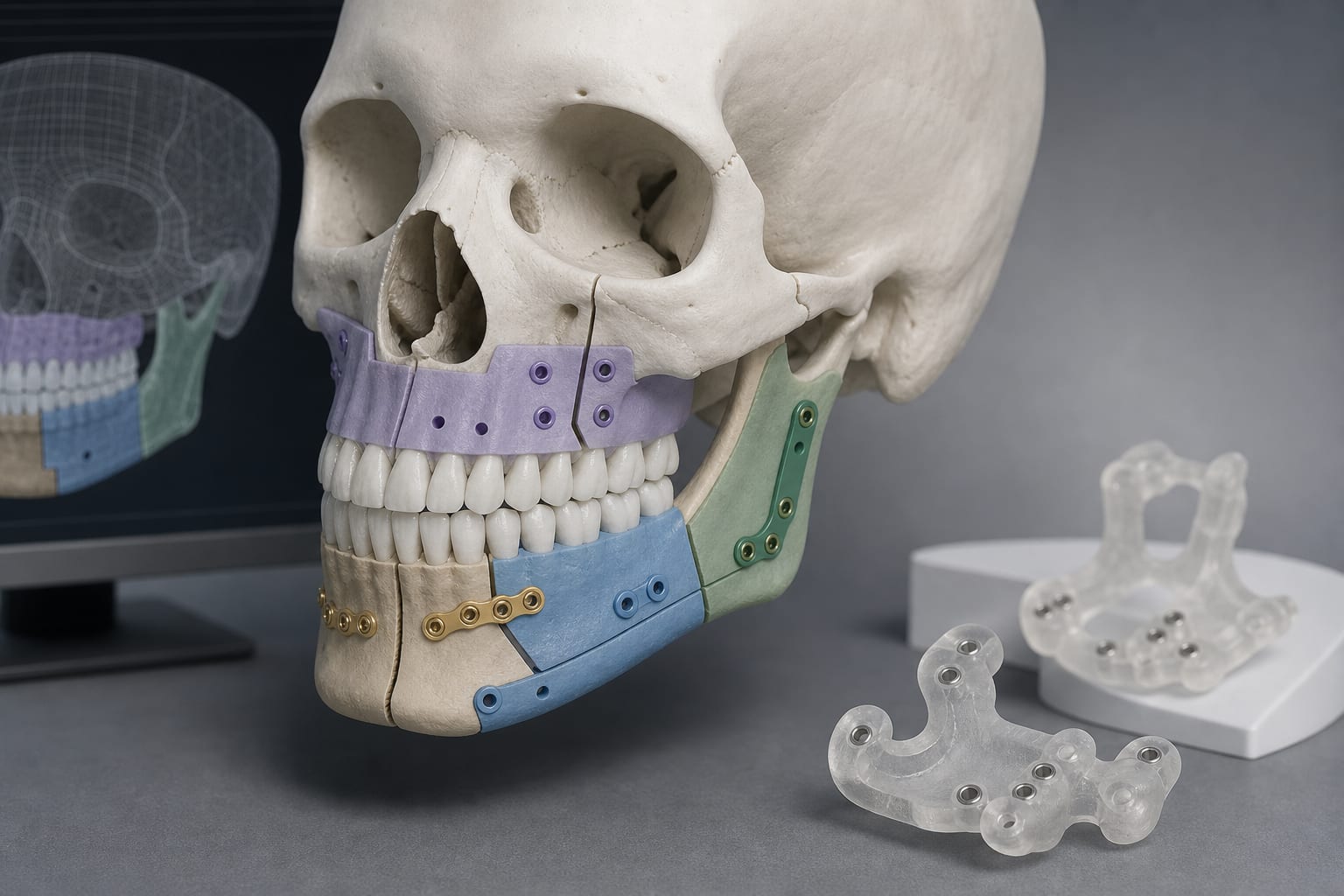
To introduce a pilot study of a modified surgery-first segmental orthognathic surgery technique for managing hemimandibular elongation (HE) and evaluate its surgical accuracy and mid-term outcomes.
Approach:
Surgical Evaluation: Surgical accuracy was assessed by comparing 3D models obtained postoperatively with preoperative virtual surgical planning, and mid-term skeletal stability was evaluated at 6-12 months post-surgery. Symmetry-related parameters such as chin deviation, chin rotation, bilateral mandibular body length discrepancy, and asymmetry index were measured.
Key Findings:
All patients healed without major complications.
Mean 3D deviation between virtual surgical planning and postoperative models was 1.58 ± 0.39 mm.
Significant improvements in symmetry parameters (chin deviation, chin rotation, bilateral mandibular body length discrepancy, and asymmetry index) were observed at 1 week postoperatively (p < 0.05).
No significant changes in symmetry parameters were noted from 1 week to mid-term follow-up.
Interpretation:
The modified surgery-first segmental orthognathic surgery technique demonstrates good surgical accuracy and immediate improvement in facial symmetry.
Limitations:
Small sample size of nine patients limits generalizability.
Short follow-up duration (mean 8.2 months) may not capture long-term outcomes, which is a critical consideration.
Conclusion:
The study provides proof-of-concept for a novel surgical approach to correct complex facial asymmetry in patients with hemimandibular elongation.