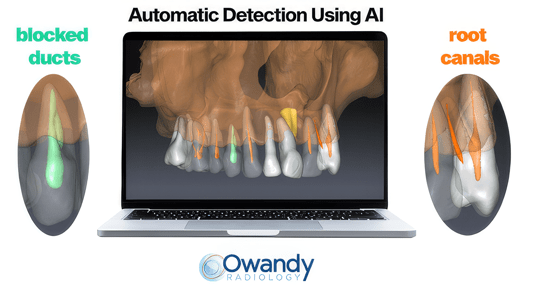
Owandy Radiology will introduce AI-powered segmentation in QuickVision 3D, its implant planning software, to separate anatomical structures on CBCT scans for clinician review.
Approach:
Feature: The software automatically segments CBCT scans into the maxilla, mandible, individual teeth from crown to root, and anatomical canals, including the mandibular canal.
Workflow: QuickVision 3D also supports image review, digital impression overlays, implant simulation, and surgical guide design and export for 3D printing.
Availability: Owandy plans to demonstrate the feature at the Greater New York Dental Meeting, November 29–December 1, 2026, at booth 3614.
Key Findings:
Owandy says the feature is designed to help clinicians assess bone volume, root anatomy, and anatomical structures relevant to implant placement.
The company describes potential endodontic applications: isolating teeth from crown to root so clinicians can examine root anatomy and evaluate root canals on CBCT scans.
Clinicians are responsible for reviewing and validating AI-generated segmentation before using it for treatment planning.
Interpretation:
Owandy describes the feature as a way to automatically separate anatomy for clinician review within its existing digital planning workflow.
Limitations:
The article provides no study results or performance data for the segmentation feature.
The article states that clinicians must verify the AI-generated segmentation.
Conclusion:
Owandy plans to demonstrate QuickVision 3D’s AI segmentation feature at the Greater New York Dental Meeting, November 29–December 1, 2026.
Leo Malin, DDS, discusses how clinical challenges inspired him to develop his own implant system and why education remains central to his approach to innovation with Implant Logistics.